News
Windows Dev Kit 2023 ('Project Volterra') Debuts as Arm Device for Developers
Microsoft yesterday debuted Windows Dev Kit 2023 to help developers create Windows apps to run on Arm-powered devices.
Formerly called "Project Volterra," the kit was introduced at Microsoft's Build conference in May, when the company said it "will enable developers to take advantage of the powerful integrated neural processing unit (NPU) to build apps that execute local AI-accelerated workloads. As an Arm-powered device powered by the Snapdragon compute platform, it will enable Windows developers to build, test and debug Arm-native apps alongside all their favorite productivity tools, including Visual Studio, Windows Terminal, WSL, VSCode, Microsoft Office and Teams."
The centerpiece of the kit is an Arm-powered device featuring the Snapdragon 8cx Gen 3 Compute Platform and utilizing the Qualcomm Neural Processing SDK, along with 32 GB of RAM and 512 GB of fast storage, multiple ports including built-in Wi-Fi 6, physical ethernet, 3x USB-A, 2x USB-C and a Mini Display port for connectivity to devices, displays and networks. Coming also with Windows 11 Pro and a one-year limited hardware warranty, it's now on sale for $599.99, but only in eight countries: Australia, Canada, China, France, Germany, Japan, the United Kingdom and the United States.
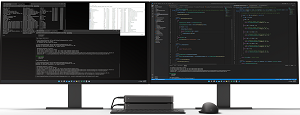 [Click on image for larger view.] Stacked Windows Dev Kits 2023 (source: Microsoft).
Microsoft has made a big push into the Arm arena, so the kit joins this list of Arm-native dev tools:
- IDEs
- VS Code (Available now)
- Visual Studio 2022 (now in preview, will be available by end of year 2022)
- Tools
- Libraries
- VC++ Runtime Libraries (Now in preview)
- Many OSS libraries are and will be ported to natively target Arm64
- Runtimes & Frameworks
- .NET 6 (Available now)
- .NET 7 (Now in preview, will be available by end of year 2022)
- OpenJDK Java (Available now)
- Python, Node JS (Porting underway)
- CLANG/LLVM, GCC (Porting underway)
- Cloud services
- Azure Arm VMs (Available now)
- Stand-alone Runner Agent (Details coming late summer 2022)
- GitHub & Azure DevOps cloud hosted CI/CD (Details to follow)
"Enterprise developers will be able to enjoy developer workflow that is just as effective and efficient as what they are used to today," Microsoft said. "By using these Arm-native tools, enterprise developers will be able to build apps and experiences that natively target Arm devices."
Microsoft said more apps, tools, frameworks and packages being ported to natively target Windows on Arm are expected to arrive over the coming months. "In the meantime, thanks to Windows 11's powerful emulation technology, developers will be able to run many unmodified x64 and x86 apps and tools on their Windows Dev Kit," the company said.
About the Author
David Ramel is an editor and writer at Converge 360.