
AdaBoost.R2 regression works by building an ensemble of decision trees, training them on reweighted data, and combining their predictions with a weighted median, while also showing how parameter choices affect accuracy and overfitting.
- By James McCaffrey
- 06/01/2026

Dr. James McCaffrey presents a complete end-to-end demonstration of quadratic regression, implemented from scratch, with pseudo-inverse training, using the C# language. Compared to standard linear regression, quadratic regression is better able to handle data with a non-linear structure and interactions between predictor variables. Compared to other types of training, pseudo-inverse does not require any parameters that must be determined by trial and error.
- By James McCaffrey
- 05/01/2026
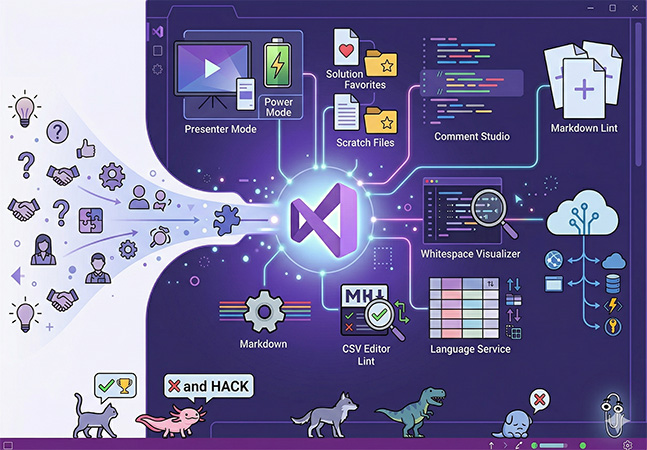
In a new video, Mads Kristensen walked through 10 extensions and updates aimed at common developer requests, spanning workspace modes, comment handling, scratch files, Markdown linting, CSV editing, Azure resource access and even animated pets.
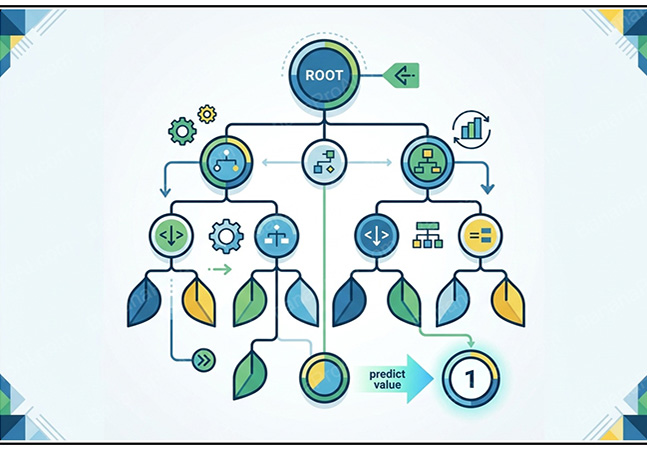
Dr. James McCaffrey presents a complete end-to-end demonstration of decision tree regression from scratch using JavaScript. The goal of decision tree regression is to predict a single numeric value. For simplicity and better maintenance, the demo implementation uses list storage instead of pointers. For better customization and interpretability, the implementation uses list iteration instead of recursion or a stack algorithm.
- By James McCaffrey
- 04/01/2026

Dr. James McCaffrey presents a complete end-to-end example of random forest regression to predict a single numeric value, implemented using C#. A random forest is a collection of basic decision tree regressors that have been trained on different subsets of the source training data. The technique reduces model overfitting to give more accurate predictions on new, previously unseen data.
- By James McCaffrey
- 03/18/2026

Dr. James McCaffrey presents a complete end-to-end demonstration of quadratic regression, with SGD training, implemented from scratch, using JavaScript. Compared to standard linear regression, quadratic regression is better able to handle data with a non-linear structure, and data with interactions between predictor variables.
- By James McCaffrey
- 03/11/2026

Claude Code has pulled ahead of OpenAI's Codex in VS Code Marketplace adoption metrics for tools tagged with "agent," just one way to judge these tools for your particular needs in this rapidly evolving space.

Dr. James McCaffrey presents a complete end-to-end demonstration of decision tree regression from scratch using the C# language. The goal of decision tree regression is to predict a single numeric value. The demo implementation doesn't use pointers (references) for simplicity and does not use recursion for better maintainability and customization.
- By James McCaffrey
- 02/17/2026

Dr. James McCaffrey presents a complete end-to-end demonstration of linear regression with pseudo-inverse training implemented using JavaScript. Compared to other training techniques, such as stochastic gradient descent, pseudo-inverse training does not require any parameters and so it is especially simple to use.
- By James McCaffrey
- 02/02/2026

A new Visual Studio Code extension called Nogic sparked a wide-ranging Hacker News discussion, with commenters praising its graph-based approach to understanding complex codebases while also raising concerns about performance, scalability, and its initially closed-source status.

Dr. James McCaffrey presents a complete end-to-end demonstration of quadratic regression, implemented from scratch, with SGD training, using C#. Compared to standard linear regression, quadratic regression is better able to handle data with a non-linear structure, and data with interactions between predictor variables.
- By James McCaffrey
- 01/21/2026

A review of five non-Copilot AI coding assistants available in the Visual Studio Marketplace that support Visual Studio 2026 and exceed 100,000 installs.

Dr. James McCaffrey presents a complete end-to-end demonstration of the kernel ridge regression technique to predict a single numeric value, implemented using JavaScript. The demo trains the model using kernel matrix inverse (Cholesky decomposition). There is no single best machine learning regression technique, but when kernel ridge regression prediction works, it is often highly accurate.
- By James McCaffrey
- 01/06/2026

Dr. James McCaffrey presents a complete end-to-end demonstration of linear regression using pseudo-inverse training. Compared to other training techniques, such as stochastic gradient descent, pseudo-inverse training does not require any parameters and so it is especially simple to use.
- By James McCaffrey
- 12/15/2025

Dr. James McCaffrey presents a complete end-to-end demonstration of anomaly detection using k-means data clustering, implemented with JavaScript. Compared to other anomaly detection techniques, k-means anomaly detection is simple to implement, simple to interpret, and simple to customize.
- By James McCaffrey
- 12/01/2025

Dr. James McCaffrey presents a complete end-to-end demonstration of decision tree regression from scratch using the C# language. The goal of decision tree regression is to predict a single numeric value. The demo implementation uses pointers (references) for efficiency but does not use any recursion for better maintainability and customization.
- By James McCaffrey
- 11/20/2025

Dr. James McCaffrey presents a complete end-to-end demonstration of ANOVA (analysis of variance) using JavaScript. ANOVA is a classical statistics technique where the goal is to determine if the unknown means (averages) of three or more groups are likely to all be equal or not, based on the variances of samples from the groups.
- By James McCaffrey
- 11/03/2025

Dr. James McCaffrey presents a complete end-to-end demonstration of Tsetlin Machine binary classification using the C# language. Tsetlin Machine models have characteristics of propositional logic, rule-based systems, and finite state automata. Tsetlin Machine systems require predictor values to be binary encoded and therefore the systems are very flexible and computationally efficient in terms of each operation, but computationally expensive in terms of number of operations.
- By James McCaffrey
- 10/15/2025

A roundup of the six most-installed "agentic" AI extensions in the VS Code Marketplace reveals how tools like Cline, BLACKBOXAI Agent, Continue, Codex, Roo Code, and Qodo Gen are transforming code editors into autonomous, context-aware development partners.
Dr. James McCaffrey presents a complete end-to-end demonstration of linear regression with two-way interactions between predictor variables. Standard linear regression predicts a single numeric value based only on a linear combination of predictor values. Linear regression with interactions between predictor variables can handle more complex data while retaining a high level of model interpretability.
- By James McCaffrey
- 10/01/2025