News
Azure Functions, App Service Go On-Premises
Two cloud development services -- Azure Functions and Azure App Service -- are now available on Azure Stack, which brings cloud functionality to on-premises implementations.
Azure Stack extends the Azure cloud to local datacenters, providing a hybrid model for building applications and services. Its use cases include edge and disconnected environments, or fulfilling security and compliance requirements.
The hybrid platform now supports Azure Functions -- for event-driven, "serverless" computing using languages such as JavaScript, C# and F# -- and Azure App Service, which lets Visual Studio developers create Web and other kinds of apps for any platform or device. Azure App Service is a fully managed Platform-as-a-Service (PaaS) offering -- running on Windows or Linux -- that uses built-in templates to create apps using C#, Java, Go, PHP, Python and more.
Microsoft said the benefits of the service include:
- Multiple languages and frameworks: App Service has first-class support for ASP.NET, Node.js, Java, PHP, and Python. Developers can also run Windows PowerShell and other scripts or executables on App Service virtual machines (VMs).
- DevOps optimization: Set up continuous integration and deployment with GitHub, local Git, or BitBucket. Promote updates through test and staging environments. Devs can manage their apps in App Service via Azure PowerShell or the cross-platform command-line interface (CLI).
- Visual Studio integration: Dedicated tools in Visual Studio streamline the work of creating and deploying applications.
In addition to Web apps, the service accommodates: API Apps for hosting RESTful APIs; Azure Functions for hosting serverless workloads; native and cross-platform mobile apps; and Web Apps for Containers .
Microsoft has been running technical previews of App Service on Azure Stack for more than a year and just yesterday announced its general availability (along with Azure Functions) on Azure Stack.
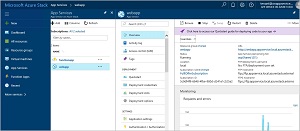 [Click on image for larger view.] App Services on Microsoft Azure Stack (source: Microsoft).
"You don’t have to learn two different platforms, one for on-premises and another for cloud, to develop and manage your portfolio of applications," said Stella Lin, senior product manager, Azure. "Even better, you will get all the high-productivity benefits, including continuous integration, continuous delivery, and deployment slots, that come with Azure App Service inside your own datacenter."
Developers must meet many prerequisites to run App Service on Azure Stack, which are detailed here. Some five-minute quickstarts for .NET, Node.js, PHP, Java, Python and HTML are available here, along with step-by-step tutorials, links to free Pluralsight training, samples and more resources.
About the Author
David Ramel is an editor and writer at Converge 360.