News
Visual Studio Code Gets Boost for Java, Spring Boot Development
As part of a wide-ranging collaboration with Pivotal Software Inc., Microsoft's Visual Studio Code editor is getting improved support for Java and Pivotal's Spring Boot framework in the form of new and enhanced extensions.
At its SpringOne conference, Pivotal announced closer ties with Microsoft development tooling, including a beta offering of the Pivotal Cloud Foundry -- an open source, multi-cloud application platform as a service -- for Azure Stack, which brings Microsoft's cloud platform's functionality to on-premises environments.
The beta offering of Pivotal Cloud Foundry on Microsoft Azure in the Azure Marketplace was described by Microsoft as a "small footprint runtime" packaged in a new, lightweight image that requires 70 percent fewer virtual machines (VMs).
Along with Azure/Pivotal integrations, Microsoft also announced it's now easier to develop and debug Java functions in the open source, cross-platform Visual Studio Code editor, following a preview of Java support for Azure Functions -- Microsoft's "serverless" computing offering -- that was announced in October.
Incorporating developer feedback from the preview, Microsoft said it made some key improvements to its Java support for the serverless platform, along with new functionality.
The new features, which Microsoft said are designed to make the experience of coding Java functions on Azure more enjoyable, include remote debugging support and an Azure Functions extension for VS Code.
With the former, coders who previously had to test and debug Java functions using a local emulator can now attach the editor's debugger to remote functions running on Azure, facilitating more complex and real-world-like scenarios.
The new Azure Functions extension preview, meanwhile, lets programmers develop, test and deploy Java functions directly to the Azure cloud -- as well as manage existing functions -- from within the editor, which runs on Windows, macOS and Linux.
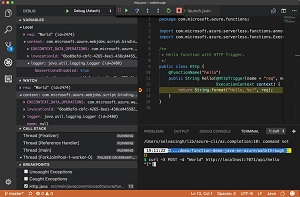 [Click on image for larger view.] A Serverless Function in Java Debugged Using Visual Studio Code (source: Microsoft).
While the Azure Functions extension comes from Microsoft, Pivotal also shared new extensions in the marketplace that come bundled in the Spring Boot Development Extension Pack for VS Code.
It includes four separate extensions for working with Spring Boot, a low-configuration option that takes an "opinionated" view of building production-ready Spring applications with an approach that favors convention over configuration in order to get developers up and running quickly with minimal hassle.
Spring Boot is a complementary offering to the open source, layered Java/J2EE Spring Framework, one of the most popular programming and configuration models for developing modern Java-based enterprise applications on any deployment platform.
As part of Pivotal's effort to make Spring Boot development easier for developers using an editor of their choice -- including VS Code -- the extension pack provides: support for code-completion; validation and assistance for application property files; navigation shortcuts; the ability to inspect running apps; and more.
Microsoft said the extension pack can be used in conjunction with another Pivotal offering -- Spring Initializr -- to initiate, create and deploy applications anywhere, including Pivotal Cloud Foundry on Azure and Azure Stack. Spring Initializr helps developers handle dependency management in their applications while also serving to ease the bootstrapping process for Spring projects.
To further Spring Initializr functionality in the Azure cloud, Microsoft announced new Spring Boot Starters for Azure.
The four initial offerings include:
- Azure Support: Provides support for the Azure services below, plus all other services currently available via Spring Boot Starters.
- Azure Active Directory: Enterprise grade authentication using Azure Active Directory.
- Azure Key Vault: Manage application secrets using Azure Key Vault.
- Azure Storage: Integration with Azure Storage including object storage, queues, tables and more.
For further information, developers can check out the developer hub for Spring Framework on Azure, a Serverless Java Apps with VS Code tutorial, the Azure Functions Java developer guide; the Azure Spring Boot GitHub repository; and yesterday's blog post titled "Bringing hybrid cloud Java and Spring apps to Azure and Azure Stack."
About the Author
David Ramel is an editor and writer at Converge 360.