News
Visual Basic, R, TypeScript Jump in Programming Language Popularity
Visual Studio-backed programming languages fared well in the latest TIOBE Index popularity report, with Visual Basic and R jumping up in the rankings and TypeScript cracking the top 100 for the first time.
The June report showed a relatively stable top 10 compared to last year (with C# and Visual Basic .NET remaining at No. 5 and No. 6, respectively), with one notable exception being R moving up four spots to claim No. 10.
While R is open source, the company Revolution Analytics provided commercial support for the language in its own Revolution R distribution, and in 2015 that company was bought by Microsoft, which integrated the language into its Visual Studio IDE.
Visual Basic (classic, as opposed to VB.NET) moved up three spots from No. 16 last year to No. 13 this year.
What's more, TypeScript -- created by Microsoft five years ago -- vaulted into the top 100 for the first time.
"This month TypeScript debuts at position 93 in the TIOBE index top 100," the TIOBE report said. "The Microsoft language has been tracked for a couple of years now, but although its popularity in industry seems high, it never made it to the top 100. So finally it has got sufficient traction to be noticed.
"TypeScript is a strict superset of JavaScript, which means you can use it together with your existing JavaScript. But it adds a lot of extra type safety to the JavaScript language thanks to type annotations. In this sense it is an improved version of JavaScript. The fact that Google adopted TypeScript next to its own JavaScript variant language Dart is proof that TypeScript has a bright future."
In total, Visual Studio provides first-class support for six of the top 10 languages listed in the TIOBE report -- C#, VB, C++, JavaScript, TypeScript and Python -- with the others being F# and R.
Here's the TIOBE Index June top 20:
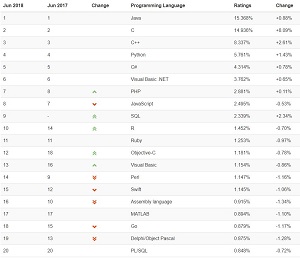 [Click on image for larger view.] TIOBE Index June Top 20 (source: TIOBE Index).
Here's the official description of the index:
The TIOBE Programming Community index is an indicator of the popularity of programming languages. The index is updated once a month. The ratings are based on the number of skilled engineers world-wide, courses and third party vendors. Popular search engines such as Google, Bing, Yahoo!, Wikipedia, Amazon, YouTube and Baidu are used to calculate the ratings. It is important to note that the TIOBE index is not about the best programming language or the language in which most lines of code have been written.
The index can be used to check whether your programming skills are still up to date or to make a strategic decision about what programming language should be adopted when starting to build a new software system. The definition of the TIOBE index can be found here.
About the Author
David Ramel is an editor and writer at Converge 360.