News
Azure IoT Dev Tooling, Security Service Make GA Debuts
Microsoft-centric Internet of Things (IoT) development was bolstered with the recent release of Azure IoT Edge Tooling and Azure Security Center for IoT, both of which are now generally available.
Azure IoT Edge, described as cloud intelligence deployed locally on IoT edge devices, is a fully managed service built on Azure IoT Hub, helping developers deploy AI, services from Azure or third parties and custom business logic to edge devices in containers.
The open source project hit GA in June, working with use cases such as machine learning, stream analytics, SQL Server databases and more.
Now, the associated tooling has also become generally available, consisting of:
More information on the tooling is available here.
Microsoft also announced the general availability of the Azure Security Center for IoT, which helps developers and pros manage their security posture for cloud workloads, follow best practices and fix common Azure infrastructure misconfigurations.
"Azure Security Center allows you to protect your end-to-end IoT deployment by identifying and responding to emerging threats, as well as finding issues in your configurations before attackers can use them to compromise your deployment," Microsoft said. "As organizations use Azure Security Center for IoT to manage their security roadblocks, they remove the barriers keeping them from business transformation."
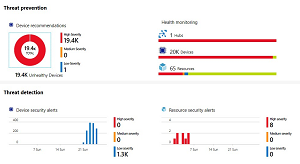 [Click on image for larger view.] Azure Security Center for IoT (source: Microsoft).
The company said the security service goes beyond just protecting devices, a common target, also covering IoT components such as cloud services, supporting infrastructure, and the accounts of admins who access them. Microsoft claims the service is the first of its kind to prevent, detect and help remediate potential attacks against such a variety of IoT components including small sensors, edge computing devices and gateways, Azure IoT Hub, the compute, storage, databases and AI/ML workloads.
The service provides a list of potential threats, ranked by importance, along with possible misconfigurations and insecure settings to help with remediation and fixes.
Microsoft said its emphasis on IoT security addresses a major problem, as exemplified in Bain research that indicates security concerns are the main reason organizations have slowed or paused IoT implementations.
"Because IoT requires integrating many different technologies (heterogeneous devices must be linked to IoT cloud services that connect to analytics services and business applications), organizations face the challenge of securing both the pieces of their IoT solution and the connections between those pieces," Microsoft said. "Attackers target weak spots; even one weak device configuration, cloud service, or admin account can provide a way into your solution."
About the Author
David Ramel is an editor and writer at Converge 360.