News
Microsoft Intros Azure Well-Architected Framework Best Practices
Taking a page from the Amazon Web Services (AWS) book on cloud computing platforms, Microsoft has introduced its own Azure Well-Architected Framework, providing a set of architecture best practices to help users build and deliver great solutions and improve the quality of cloud workloads.
With Microsoft noting that its new offering follows industry standards and terms, the Microsoft Azure Well-Architected Framework borrows heavily from the AWS Well-Architected Framework that has been around for years, almost directly copying the "five pillars" upon which the AWS framework is built:
| AWS Pillars |
Azure Pillars |
| Operational excellence |
Cost management |
| Security |
Operational excellence |
| Reliability |
Performance efficiency |
| Performance efficiency |
Reliability |
| Cost optimization |
Security |
Microsoft said its five pillars provide:
- Managing costs to maximize the value delivered: "An effective architecture achieves business goals and ROI requirements while keeping costs within the allocated budget."
- Operations processes that keep a system running in production: "To ensure that your application is running effectively over time, consider multiple perspectives, from both an application and infrastructure angles. Your strategy must include the processes that you implement so that your users are getting the right experience."
- The ability of a system to adapt to changes in load: "Prioritize scalability as you design and implement phases. Scalability leads to lower maintenance costs, better user experience, and higher agility."
- The ability of a system to recover from failures and continue to function: "In a cloud environment you scale out rather than buying higher-end hardware to scale up. While it's always desirable to prevent all failure, focus your efforts in minimizing the effects of a single failing component."
- Protecting applications and data from threats: "Security is one of the most important aspects of any architecture. It provides confidentiality, integrity, and availability assurances against deliberate attacks and abuse of your valuable data and systems. Losing these assurances can negatively impact your business operations and revenue, as well as your organization's reputation in the marketplace."
"As the technology requirements of your business or practice grow and change over time, deploying business-critical applications can increase complexity and overhead substantially," Microsoft said in a July 21 blog post announcing the new well-architected framework. "To help manage this ever-growing complexity, we are pleased to announce the introduction of the Microsoft Azure Well-Architected Framework."
Along with the five architectural pillars, Microsoft detailed some consistent design principles that it advised organizations to consider throughout their architecture:
Enable architectural evolution: No architecture is static. Allow for the evolution of your architecture by taking advantage of new services, tools, and technologies when they're available.
Use data to make decisions: Collect data, analyze it, and use it to make decisions surrounding your architecture. From cost data, to performance, to user load, using data will guide you to make the right choices in your environment.
Educate and enable: Cloud technology evolves quickly. Educate your development, operations, and business teams to help them make the right decisions and build solutions to solve business problems. Document and share configurations, decisions, and best practices within your organization.
Automate: Automation of manual activities reduces operational costs, minimizes error introduced by manual steps, and provides consistency between environments.
The project also introduced a shared responsibility model, with the following graphic indicating who (provider or user) is responsible for what in a cloud computing scheme.
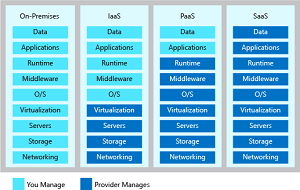 [Click on image for larger view.] Cloud Responsibility Model (source: Microsoft).
The reference framework is meant to be used by organizations in concert with the Microsoft Azure Well-Architected Review, a formalized process in which enterprises examine their workloads through lenses that match up with the five pillars.
"The Azure Well-Architected Review is designed to help you evaluate your workloads against the latest set of Azure best practices," Microsoft said. "It provides you with a suite of actionable guidance that you can use to improve your workloads in the areas that matter most to your business. Every customer is on a unique cloud journey, so we designed the Azure Well-Architected Review to be tailored to an individual company's needs. You can evaluate each workload against only the pillars that matter for that workload, so when evaluating one of your mission-critical workloads, you might examine reliability, performance efficiency, and security first and then later come back and look at the other pillars to improve your operational efficiency and cost footprint."
Also, at the Microsoft Build 2020 developer conference earlier this year, Microsoft introduced a "learning path" for the framework, titled "Build great solutions with the Microsoft Azure Well-Architected Framework." It includes six modules, one for the introduction/overview and five other that match up with the five pillars.
About the Author
David Ramel is an editor and writer at Converge 360.