News
Microsoft Updates Quantum Development Kit to .NET 6, VS 2022
Microsoft updated its Quantum Development Kit (QDK) to support.NET 6 instead of .NET Core 3.1, and Visual Studio 2022 instead of VS 2019.
"This change will enable a simpler onboarding experience for new users, allow us to offer an extension for Visual Studio 2022, and enable our contributors to leverage new features available in C# 10," Microsoft's Ricardo Espinoza said in a June 8 blog post.
The QDK was still using .NET Core 3.1 because the dev team chose to align with Long Term Support (LTS) .NET releases, which are supported for three years after initial release instead of Current releases, which are supported for 18 months.
"The last time we updated the Quantum Development Kit to a new .NET version was in January 2020 when we adopted the just released .NET Core 3.1," said Espinoza, a senior software engineer. "Since then, we made the decision to stay in the LTS version and not migrate into Current releases, which have a shorter support period. This provides stability and avoids possible disruptions when migrating from one version to another while at the same time. It also ensures that the QDK runs on a fully supported .NET release."
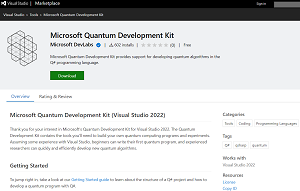 [Click on image for larger view.] Microsoft Quantum Development Kit Extension (source: Microsoft).
At the same time, the team decided to support VS 2022, which arrived with .NET 6 last November. That required a new Visual Studio extension in the IDE's marketplace. Now, the new Microsoft Quantum Development Kit extension for "developing quantum algorithms in the Q# programming language" shows 602 installations. "The Quantum Development Kit contains the tools you'll need to build your own quantum computing programs and experiments," its marketplace entry states. "Assuming some experience with Visual Studio, beginners can write their first quantum program, and experienced researchers can quickly and efficiently develop new quantum algorithms."
For those who don't want to update to VS 2022, the old and no-longer-updated VS 2019 QDK extension is still available, showing more than 80,000 installs and earnings an average 3.6 (scale 1-5) from 52 developers who reviewed it.
The announcement post details how to migrate existing projects.
"If you have an older project that references an previous version of the QDK you can continue using it as is with the Visual Studio Code and Visual Studio 2019 extensions; however, you might also want to manually update those Q# projects to a newer version of the Quantum Development Kit to benefit from newer features or if you have migrated to Visual Studio 2022," Espinoza said.
About the Author
David Ramel is an editor and writer at Converge 360.