News
OpenSilver 3.0 Framework for .NET Gets UI by AI
A new AI-powered UI designer highlights the new release of OpenSilver 3.0, a free, open-source UI framework for building modern .NET web applications in C# and XAML.
The tool, basically a reimplementation of Microsoft Silverlight that runs on current browsers via WebAssembly, is now previewing integrated AI functionality in OpenSilver 3.0, which helps users generate complex UIs and make modifications using natural language commands. Devs can now simply describe desired changes and see the XAML updated automatically.
The open source tooling is offered up with optional professional support by Userware, which provided examples of these natural language prompts that result in instant coding changes:
- "Create a landing page for a product named AdventureWorks CRM"
- "Add a navigation menu at the top, change the style to use pastel colors, make the text black"
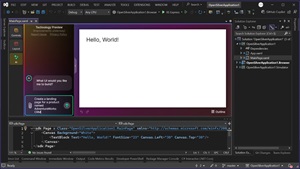 [Click on image for larger view.] AI-Powered UI (source: OpenSilver/Userware).
In addition to the natural language input, devs can also upload an image or a mockup to have the AI generate an approximation.
"Users can alternate between AI-driven changes, the drag-and-drop designer, and the manual XAML coding, providing an ideal mix of automatic generation and fine-grained customization," the company said in a news release.
Also on the AI front, the company launched UseCasesFor.ai, featuring more than 250 examples of AI applications across various industries.
Another new feature is XAML.io, described as the first online XAML designer that helps devs start building apps directly in the web browser -- no installation required -- then transition to Visual Studio for further development and deployment. The site XAML.io was itself built using OpenSilver.
"It allows .NET developers to start building applications directly in their web browsers, eliminating the need for local installations," the company said. "Developers can start their projects online and then transition to Visual Studio to further develop or deploy their applications."
The project's roadmap of what's coming next includes:
- .NET MAUI Hybrid Support: Enabling developers to deploy native applications across iOS, Android, Windows, and macOS.
- Blazor Components in XAML: Seamless integration of Blazor and JavaScript components within C# and XAML code.
- XAML 3D (Preview available at XRSharp.io): Add interactive 3D elements to your OpenSilver apps, mix and match 2D and 3D XAML, and share ViewModels. Leverage your WPF app creation skills to create stunning 3D websites compatible with all browsers, and WebXR-powered Mixed Reality experiences for devices like Meta Quest and Apple Vision Pro, all using only .NET, C#, and XAML.
About the Author
David Ramel is an editor and writer at Converge 360.