News
AWS Updates .NET Deploy Tool to Version 2.0 with .NET 8 and Podman Support
Amazon Web Services has released Version 2.0 of its AWS Deploy Tool for .NET, bringing major under-the-hood changes designed to align with current Microsoft-supported runtimes and modern container workflows. The tool now requires .NET 8 and introduces Podman support alongside several other developer-focused enhancements.
According to documentation, the tool is used for:
- Compute recommendations for your application -- Get recommendations about the type of compute best suited for your application based on the application type.
- Dockerfile generation - The tool will generate a Dockerfile if needed, otherwise an existing Dockerfile will be used.
- Auto packaging and deployment -- The tool builds the deployment artifacts, generates a deployment CDK project, provisions the infrastructure, and deploys your application to the chosen AWS compute.
- Repeatable and shareable deployments -- You can generate and modify AWS Cloud Development Kit (CDK) deployment projects to fit your specific use case. You can also version control your projects and share them with your team for repeatable deployments.
- Help with learning AWS CDK for .NET! - Gradually learn the underlying AWS tools that AWS Deploy Tool for .NET is built on, such as the AWS CDK.
The AWS Deploy Tool for .NET now runs on .NET 8, replacing the out-of-support .NET 6 runtime. AWS said this requirement ensures that the tool remains secure and compatible with future updates. Developers must also have Node.js 18.x or later installed because the AWS Cloud Development Kit (CDK)--a core dependency--has raised its minimum supported version to Node.js 18.Aside from these prerequisites, AWS said that existing deployment configurations and command structures remain unchanged, so most users should expect a straightforward upgrade.
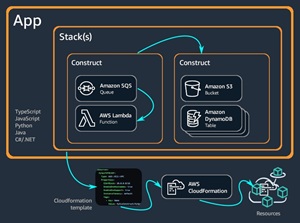 [Click on image for larger view.] The App Stack in the AWS CDK (source: AWS).
New Features and Improvements
The new release expands container engine compatibility to include Podman in addition to Docker. The tool automatically detects both and defaults to Docker if it's running, otherwise switching to Podman. This provides developers more flexibility while maintaining predictable behavior.Version 2.0 also adds support for deploying .NET 10 applications. For targets such as AWS Elastic Beanstalk that may not yet include a managed .NET 10 runtime, the deploy tool can publish a self-contained bundle that includes all required dependencies and the runtime itself.Other updates include optimized Dockerfile generation for container deployments, a switch to the Spectre.CLI library for future improvements like interactive guided deployments, updated AWS CDK and CLI versions, an upgrade to AWS SDK for .NET v4, and a templating engine upgrade from .NET 5 to .NET 8.
How to Update
The new version is available via both the .NET CLI and Visual Studio. Developers can update with:
dotnet tool update -g AWS.Deploy.Tools
or install it new with:
dotnet tool install -g AWS.Deploy.Tools
In Visual Studio, the updated deployment features are included in the AWS Toolkit for Visual Studio, available through the Extensions > Manage Extensions menu.
Next Steps
AWS said it plans to continue expanding the tool's capabilities to simplify .NET application deployment to the cloud. The project is open source, and feedback is encouraged via GitHub. The full announcement is available on the AWS Developer Tools Blog.
About the Author
David Ramel is an editor and writer at Converge 360.