News
Microsoft Quietly Kills IntelliCode as AI Strategy Shifts to Subscription Copilot
Microsoft has officially begun decommissioning its IntelliCode suite, marking the end of a multi-year effort to provide local, machine-learning-assisted code completions.
The move, executed alongside the VS Code 1.107 (November 2025) update, shifts Microsoft's AI developer strategy entirely toward the subscription-based GitHub Copilot ecosystem.
The under-the-radar announcements came last month in GitHub repos, an
IntelliCode for C# Dev Kit Deprecation Announcement #2537 and an
IntelliCode Extensions for VS Code Are Being Deprecated #614 issue.
The
vscode-java-pack repo also noted the move, marking it as **URGENT**.
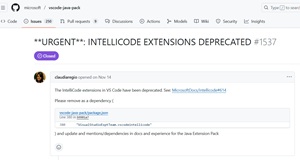 [Click on image for larger view.] **URGENT**: INTELLICODE EXTENSIONS DEPRECATED (source: GitHub).
End of Life for VS Code Extensions
The deprecation primarily targets Visual Studio Code users, where the local GPT-C models that powered IntelliCode have been a staple for millions of developers. On Nov. 12, 2025, Microsoft archived the primary IntelliCode repository and issued a formal deprecation notice. The company stated that "starred" completions--which used local models to prioritize IntelliSense lists--will no longer be shown, and gray-text inline suggestions have been removed.
The following extensions are now officially deprecated:
As can be seen, cumulatively these extensions had amassed over 70 million downloads in the VS Code Marketplace.
Microsoft's guidance is direct: "We recommend using GitHub Copilot, which provides advanced suggestions and inline completions." While standard language servers like Roslyn will continue to provide basic IntelliSense, the AI-assisted features are now tied to the Copilot engine.
Visual Studio 2026: A Different Path
In contrast to the hard deprecation in VS Code, the recently released Visual Studio 2026 (Version 18.0) retains IntelliCode as an optional component in the installer. Microsoft has moved the IDE to a Modern Lifecycle Policy, which involves shipping a new major version every year. Under this policy, feature development is focused on the latest version, while older components eventually face removal from the primary workflow.
While IntelliCode remains available as an individual component in VS 2026, it is no longer the focus of Microsoft's AI investments. New productivity features like Adaptive Paste and Agent HQ orchestration are explicitly built into the GitHub Copilot workflow.
Comparison: IntelliCode vs. GitHub Copilot (2025)
| Feature |
IntelliCode (Deprecated) |
GitHub Copilot Agents (New) |
| Primary Engine |
Local GPT-C Models |
Cloud-based LLMs (GPT-4o, Claude, Gemini) |
| Data Privacy |
Local execution; code stays on machine |
Cloud-based; depends on subscription plan |
| Connectivity |
Works offline & in air-gapped environments |
Requires active internet connection |
| Cost |
Free (Included in IDE) |
Free (Metered) or Paid ($10-$39/mo) |
| Completion UI |
Starred (⭐) list items & single-line text |
Multi-line ghost text & "Agent Mode" edits |
The Cost of "Free" AI
For the millions of developers using VS Code, the end of IntelliCode represents a shift from unlimited local utility to a metered cloud service. While Microsoft markets GitHub Copilot Free as a replacement, it introduces strict usage caps: the Free tier is limited to 2,000 code completions and 50 chat or "agent mode" requests per month. Once a user reaches these limits, AI features in VS Code are disabled. Unlike Visual Studio 2026, which can fall back to its built-in IntelliCode component, the archived VS Code extensions leave developers without AI assistance until they upgrade to a paid Pro plan.
In an article titled "VS Code Pushes Hard on AI Agents While Quietly Killing Free Code Completion," Tom Smith of DevOps.com characterizes the move as "IntelliCode Dies, Copilot Subscriptions Live," noting that for a feature that was previously free and unlimited, Microsoft is now effectively moving toward a model that requires $120 to $228 per year for heavy users.
Industry Perspective on the Shift
Industry analysts view the removal of IntelliCode as a move to eliminate product overlap and force a transition to the newer "agent" architecture. Mitch Ashley, VP and practice lead at The Futurum Group, notes that "What we are seeing in VS Code reflects a broader industry reality in which vendors must rationalize overlapping products, experimental capabilities, and new messaging as AI is layered onto mature platforms," as discussed in recent industry analysis of the AI development landscape.
Local Alternatives for the Privacy-Conscious
For developers who require offline capabilities or wish to maintain the "local-only" privacy model of IntelliCode, several third-party alternatives have matured in 2025:
- Continue: An open-source extension for VS Code that allows you to swap cloud models for local ones like Qwen2.5-Coder or Llama 3.1.
- Tabby: A self-hosted AI coding assistant that specializes in deterministic tab-autocomplete.
- BroPilot: A specialized extension for Visual Studio that connects the IDE to local LLM backends.
- VS Code AI Toolkit: Microsoft's own extension for downloading and running ONNX-optimized models locally.
Industry analysts note that this "silent" deprecation represents a broader trend of moving developer tools from free, local models to cloud-dependent services. As many developers have noted in community feedback threads on Hacker News and Reddit, the transition marks a shift between two fundamentally different value propositions: one provided a deterministic, local-first experience that prioritized privacy, while the other is a generative, cloud-based subscription service. The consensus among these users is that while Copilot is a more powerful synthesizer, it lacks the "quiet intelligence" and offline reliability of the local models it is replacing.
About the Author
David Ramel is an editor and writer at Converge 360.