News
Microsoft Sharpens AI Toolkit for VS Code in Foundry Update
Microsoft's February 2026 Microsoft Foundry update spans models, SDKs, orchestration, local deployment, and API changes, including updates to the AI Toolkit for VS Code.
As detailed in the March 6 update post, major new features include the general availability of the Foundry REST API v1, the Microsoft Agent Framework reaching release candidate, new Foundry Local support for large multimodal models in sovereign-cloud scenarios, plus broader model and SDK updates.
The toolkit update, detailed in Microsoft's AI Toolkit for VS Code February 2026 update post, centers on three changes that push agent work closer to a conventional software-development workflow inside the editor: a new Tool Catalog, a new Agent Inspector with F5 debugging, and a new "Evaluation as Tests" approach.
Tool Catalog Targets Agent Tool Sprawl
The new Tool Catalog is positioned as a centralized place to discover, configure, and integrate tools into agents. Microsoft said developers can browse, search, and filter tools from the public Foundry catalog and local stdio Model Context Protocol (MCP) servers, configure connection settings directly in VS Code, and manage the full tool lifecycle from one interface.
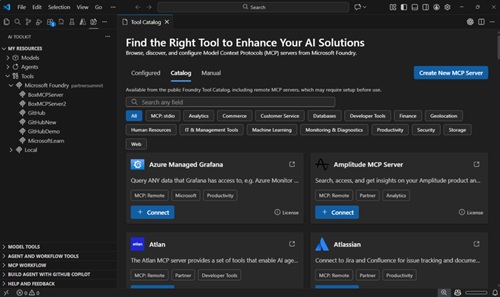 [Click on image for larger view.] New Tool Catalog Interface (source: Microsoft).
For developers building agents that depend on external tools, APIs, or MCP servers, that addresses one of the recurring friction points in agent development: figuring out what tools are available and wiring them up without bouncing among docs, config files, and disconnected setup flows (see "Navigating VS Code AI Toolkit and Microsoft Foundry for Agent Development").
Agent Inspector Brings F5 Debugging to Agent Workflows
Another major headline feature is Agent Inspector, which Microsoft describes as an end-to-end debugging experience for agents inside VS Code. The feature adds one-click F5 debugging with breakpoints, variable inspection, and step-through execution, along with real-time visibility into streaming responses, tool calls, and multi-agent workflows.
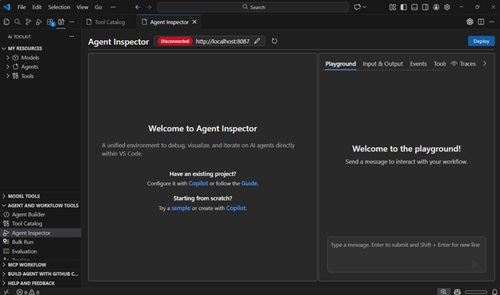 [Click on image for larger view.] Agent Inspector Interface (source: Microsoft).
Microsoft also said the Inspector supports quick code navigation, allowing developers to jump from workflow nodes back to source. That is a notable addition because it shifts agent development further into familiar IDE territory, where developers can inspect execution state and trace workflow behavior instead of treating agents as largely opaque runtime artifacts.
'Evaluation as Tests' Fits AI Quality Checks into Existing Dev Workflows
Microsoft is also trying to make model and agent evaluation look more like ordinary software testing. With "Evaluation as Tests," developers can define evaluations as test cases using pytest syntax and Eval Runner SDK annotations, run those evaluations from the VS Code Test Explorer, and analyze results in a tabular view with Data Wrangler integration.
The company also said evaluation definitions can be submitted to run at scale in Microsoft Foundry. The result is a more structured evaluation workflow aimed at making agent quality checks versioned, repeatable, and more compatible with established test and CI practices.
Other Toolkit Changes Round Out the Update
Beyond those three major changes, Microsoft also refreshed Agent Builder with a redesigned layout, a quick switcher for moving among agents, support for authoring, running, and saving Foundry prompt agents, and direct tool addition from the Tool Catalog or built-in tools. A new "Inspire Me" feature is intended to help users draft agent instructions.
Microsoft also added a new workflow entry point for generating multi-agent workflows with GitHub Copilot and said users can orchestrate workflows by selecting prompt agents from Foundry.
On the model side, the company said the Model Catalog now supports models that use the OpenAI Response API, including gpt-5.2-codex, along with general performance and reliability improvements.
The update also includes conversion and profiling changes, including interactive playground generation for history models, Qualcomm GPU recipes, and resource-usage visibility for Phi Silica directly in Model Playground. In a follow-up comment on the announcement, a Microsoft representative clarified that the Qualcomm GPU item refers to additional model conversions on Qualcomm GPUs through AI Toolkit model conversion for running models from sources such as Hugging Face on Windows devices powered by NPUs, GPUs, and CPUs.
Broader Context: AI Toolkit Continues to Expand as a Foundry Front End
The product context matters here. According to the Visual Studio Marketplace listing for AI Toolkit for Visual Studio Code, the extension pack -- still in the Preview stage with nearly 892,000 installs -- ships with the Microsoft Foundry extension built in, giving users direct access to Foundry resources from inside VS Code.
Microsoft's VS Code AI Toolkit overview documentation similarly presents the extension as a broad environment for model discovery, experimentation, agent building, evaluation, tracing, fine-tuning, and model conversion.
That broader positioning helps explain why the February update stands out. Rather than adding a single isolated feature, Microsoft is continuing to build out AI Toolkit as a more complete editor-based development surface for Foundry-related AI work.
Foundry Update Extends Beyond the Toolkit
Outside the VS Code tooling story, the broader February Foundry update also included new model rollouts, the release candidate for Microsoft Agent Framework for Python, Foundry Local support for large multimodal models in sovereign-cloud scenarios, and general availability of the Foundry REST API v1.
The company's handy pre-built TL;DR summary of the update highlights the breadth of changes across models, APIs, SDKs, and orchestration:
- Claude Opus 4.6 + Sonnet 4.6: Anthropic's frontier models arrive in Foundry with 1M-token context (beta), adaptive thinking, and context compaction -- Opus for deep reasoning, Sonnet for cost-efficient scale.
- GPT-Realtime-1.5 & GPT-Audio-1.5: Next-gen audio models with +7% instruction following, better multilingual support, and +10% alphanumeric transcription accuracy.
- Grok 4.0 (GA) + Grok 4.1 Fast (Preview): xAI's reasoning model graduates to GA; the new Fast variant lands at $0.20/M input tokens for high-throughput non-reasoning workloads.
- FLUX.2 Flex: Text-heavy image generation purpose-built for UI prototyping and typography at $0.05/megapixel.
- Microsoft Agent Framework (RC): 1.0.0rc1 for Python -- API surface locked. Major breaking changes in credentials, sessions, and response patterns. Migration guide published.
- Durable Agent Orchestration: New HITL pattern pairs Azure Durable Functions with Agent Framework and SignalR for agents that survive restarts and wait days for human approval.
- Foundry Local -- Sovereign Cloud: Large multimodal models now run fully disconnected on local hardware with APIs that mirror the cloud surface.
- AI Toolkit for VS Code v0.30.0: Tool Catalog, Agent Inspector with F5 debugging, and a redesigned Agent Builder.
- REST API v1 (GA): The core Foundry REST surface is now production-ready. SDKs across all languages are building on it in pre-release -- GA announcements imminent.
- SDK Releases Across All Languages: Python (2.0.0b4), .NET (2.0.0-beta.1), JS/TS (2.0.0-beta.4), and Java (2.0.0-beta.1) all shipped new betas targeting the GA v1 REST surface with significant breaking changes -- tool class renames, credential updates, and preview feature opt-in flags.
Still, for developers already spending their day in VS Code, the AI Toolkit changes may be the most immediate part of the update for readers of Visual Studio Magazine. The clearest theme in the release is not just more AI features, but more of the familiar mechanics of software development -- discovery, debugging, and testing -- being applied to agent development inside the editor.
About the Author
David Ramel is an editor and writer at Converge 360.