2018: When VS Code Eclipsed Visual Studio IDE
I wonder if Microsoft knew what it had on its hands back in 2015 when it created Visual Studio Code, the little code editor that could.
Did the VS Code team even envision the free, open source code editor could, in less than four years after its debut, become the No. 1 development tool in a major development survey, eclipsing its namesake IDE that can cost some $6,000 per year?
That's what happened, and the success of VS Code -- along with the evolution of the open source, cross-platform .NET Core -- provides the signature theme of 2018 in the Microsoft developer ecosystem. This was the year Microsoft finally shook off the last vestiges of its perception as a proprietary, monolithic corporate predator, transforming like a chrysalis to emerge as an open source champion.
As unlikely as it would seem, providing a free, performant and versatile code editor was probably a requirement for Microsoft to complete its journey to open source advocate. Leading the charge to .NET Core with a huge (some would say "bloated"), sometimes-costly (there is a free edition) enterprisey IDE that just runs on Windows (yes, there is a Mac version, but it's problematic) just doesn't work.
VS Code, though, fits the bill.
That was confirmed this year when Stack Overflow -- known for its huge programming Q&A site -- released its comprehensive developer survey, which polled more than 100,000 developers in 183 countries.
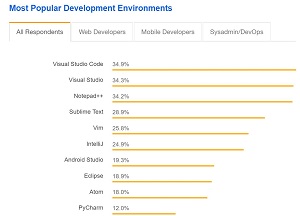 [Click on image for larger view.] No. 1 on Stack Overflow (source: Stack Overflow).
"Visual Studio Code just edged out Visual Studio as the most popular developer environment tool across the board," said Stack Overflow, which divided that "board" into four planks: All Respondents, Web Developers, Mobile Developers and Sysadmin/DevOps.
VS Code was No. 1 in the first two categories and No. 2 in the last two, finishing behind Android Studio in Mobile and Vim for Sysadmin/DevOps. In the previous year's SO survey, VS Code placed no higher than fifth place among all segments.
While it only beat out Visual Studio IDE by .6 percentage points in the SO survey, its ascension was foreshadowed some six months earlier in yet another huge developer survey conducted by yet another huge developer platform.
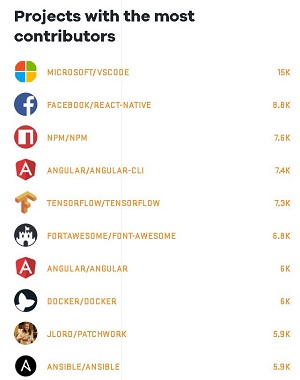 [Click on image for larger view.] 15K Contributors and Counting (source: GitHub).
This time, GitHub in its "State of the Octoverse" report saw VS Code repeat as the No. 1 open source project when measured by contributor count, which clocked in at about 15,000.
The 2018 GitHub report showed VS Code repeat in popularity (now up to some 19,000 contributors) and also -- probably not coincidentally -- noted that Microsoft was the organization with the most employees contributing to open source, with 7,700 contributors, well ahead of No. 2 Google at 5,500 contributors.
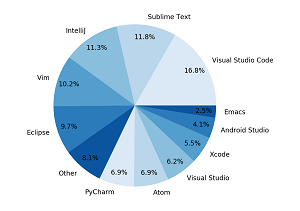 [Click on image for larger view.] Editor Usage Rates (source: Triplebyte).
And much newer research has further confirmed VS Code is on the rise, as technical recruiting specialist Triplebyte just recently noticed a huge upsurge in the code editor's use among its developer job candidates conducting rigorous interviews.
"Visual Studio Code is on the rise," Triplebyte said. "Over the past year, it has become the most popular editor across the board, and it's gaining ground every month."
While VS Code's popularity is well-known and well-charted elsewhere, this Triplebyte research certainly provided insight into the rapid hike in popularity.
For example, in discussing the above graphic, the firm said, "The first thing that jumps out from this graph is the prominence of Visual Studio Code. With 17 percent of the pie, VS Code was the editor used by the plurality of Triplebyte candidates last year. This was a surprise to me for two reasons. First, VS Code is a relatively new product from Microsoft, and, second, last year it didn't even appear on our charts -- its share was small enough to fall into the 'other' bucket."
There are still worlds to conquer, however. Looking at current IDE popularity indices, the Top IDE index from Pierre Carbonnelle shows VS Code at No. 6 (VS IDE is No. 1), though it did enjoy the biggest change in the December 2018 rankings as compared to a year ago among all the tracked offerings.
Yet another Top IDE index (from the hype.codes project) shows VS Code at No. 8, though, again, it had the highest percentage gain among all those tracked.
With those growth rates, and riding high on its incredible momentum, I expect VS Code's performance in those and other indices will look quite different next year.
I also wonder what lies ahead for VS Code and Visual Studio IDE. With its huge ecosystem of extensions that can provide just about any functionality, when does a lightweight, barebones code editor subsume a fully functioning enterprise-ready IDE? When does VS Code become so robust and performant it blurs the lines between code editors and IDEs?
After all, it already has many "IDE-like" features such as: code completion; IntelliSense; debugging; collaboration, DevOps and tool integration functionality; and so on (apparently no one really knows exactly when a code editor becomes an IDE).
When does Microsoft put Visual Studio IDE on the back burner and devote more resources to VS Code as it furthers its open source transformation?
You tell me, while you share what you like/dislike about the two tools in the reader comments section or an e-mail.
Posted by David Ramel on 12/19/2018