News
.NET Core 3.0 Nears General Availability with Preview 6
Aiming for a September general availability release, Microsoft today shipped preview 6 of .NET Core 3.0.
Officially called .NET Core 3.0.0 Preview 6, the new release pretty much finalizes Windows Presentation Foundation (WPF) and other functionality, with the dev team now focusing on quality, fixing bugs and improving performance. The team is especially looking for developers to put the release through its paces and raise issues found, as new feature requests will probably have to wait for the next release.
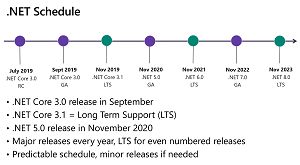 [Click on image for larger view.] The .NET Schedule (source: Microsoft).
Companion projects ASP.NET Core and EF Core also received updates.
As we reported last month, .NET Core 3.0 will be the last major update to the new cross-platform, open source direction that Microsoft is taking in lieu of the ageing, Windows-only .NET Framework. The company is skipping version 4 to avoid confusion with .NET Framework and intends to unify everything next year, dropping the "Core" designation starting with plain old .NET 5.
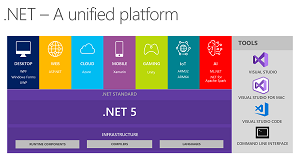 [Click on image for larger view.] .NET 5 (source: Microsoft).
As detailed in a June 12 blog post, preview 6 includes:
- Updates for compiling assemblies for improved startup, by using the ReadyToRun (R2R) format, a form of ahead-of-time (AOT) compilation
- Optimizing applications for size with linker, providing a tool that can reduce the size of apps by analyzing IL and trimming unused assemblies
- EventPipe improvements, providing support for multiple sessions
- New Docker images for Alpine on ARM64
- Publishing nearly all of the WPF codebase to GitHub
Regarding the latter, Microsoft's Richard Lander, program manager on the .NET team, noted the WPF team just published source for 15 assemblies, saying, "For anyone familiar with WPF, the assembly names should be very familiar."
"In some cases, tests are still on the backlog to get published at or before 3.0 GA," Lander continued. "That said, the presence of all of this code should enable the WPF community to fully participate in making changes across WPF. It is obvious from reading some of the GitHub issues that the community has its own backlog that it has been waiting to realize. Dark theme, maybe?"
Support for creating WPF and Windows Forms (WinForms) desktop apps for .NET Core was one of the last major initiatives in the migration, and Microsoft has been busy publishing guidance on porting desktop apps to the new framework (see "Guidance for Porting 'Complicated' Desktop Apps to .NET Core Published," "Microsoft Doubles Down on Guidance for Porting Desktop Apps to .NET Core" and "Microsoft Explains How to Port Desktop Apps to .NET Core 3.0").
The release notes provide more detail on all of the above and more, and a handy API diff between Preview 5 and 6 provides an at-a-glance summation of APIs that have been added and removed.
"Thanks for trying out .NET Core 3.0 previews," Lander concluded. "We appreciate your help. At this point, we’re focused on getting a final release in your hands."
About the Author
David Ramel is an editor and writer at Converge 360.