News
Azure SDK Gets Communications Services Libraries, Based on Teams Tech
The latest monthly update to the Azure SDK adds new Azure Communications Services Libraries that recently were promoted to v1.0 general availability.
Based on tech borrowed from Microsoft Teams meeting/collaboration software, they empower cloud developers to create applications that incorporate chat, voice calling, video calling, traditional telephone calling, SMS messaging and other real-time communication functionality, according to an announcement last week. In addition to the libraries being based on Teams tech, Teams interoperability is in a public preview.
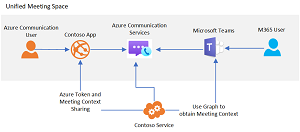 [Click on image for larger view.] Teams Interoperability (source: Microsoft).
Azure Communication Services come in many composable client libraries that support a variety of platforms and languages -- including JavaScript, .NET, Python, Java SE, iOS and Android -- at different levels and stages. Thus, some of those support all areas -- Common, Phone Numbers, Chat, SMS and Calling -- while others don't. Details about all of that can be seen in an April 5 blog post.
Specifically, according to release notes:
- Azure Communication Identity, Communication Common, Communication Chat and Communication SMS Client Libraries for Java are generally available.
- SDKs for JS for Communication Identity, Communication Common, Communication Chat and Communication SMS have released GA versions 1.0.0
Also new in the April 2021 update of the Azure SDK is more text analytics functionality and updates to Event Hubs for .NET, Python and JavaScript, with the latter detailed as:
- .NET: Added support for using
AzureNamedKeyCredential and AzureSasCredential types to authenticate Event Hubs clients. Using these credentials allow the shared key or SAS to be updated without creating a new client
- .NET: Multiple enhancements were made to the transport paths for publishing and reading events to reduce memory allocations and increase performance
- Python: Added support for using
azure.core.credentials.AzureSasCredential as credential for authenticating producer and consumer clients
- JavaScript: Added support for using
NamedKeyCredential and SASCredential as the credential type for authenticating producer and consumer clients
The release notes list other highlights as:
- Azure Cosmos DB client library for Java is releasing a new GA (Cosmos DB for Java v4.14.0)
-
Java Azure Core library is releasing a new GA:
- Introduces authentication support using a named key via AzureNamedKey and AzureNamedKeyCredential
- Adds Binary.toByteBuffer which returns a read-only view of the BinaryData and ProxyOptions.fromConfiguration(Configuration, boolean) which allows for configuring if the returned proxy
Azure SDKs are available here, while all releases are presented here.
About the Author
David Ramel is an editor and writer at Converge 360.