News
As Some Orgs Restrict DeepSeek AI Usage, Microsoft Offers Models and Dev Guidance
While some organizations are restricting employee usage of the new open source DeepSeek AI from a Chinese company due to data collection concerns, Microsoft has taken a different approach.
That approach includes offering up models along with developer guidance.
The company yesterday announced "DeepSeek R1 is now available on Azure AI Foundry and GitHub" and published guidance on "Using DeepSeek models in Microsoft Semantic Kernel" and just today published "DeepSeek-R1 on Azure with LangChain4j Demo" documentation. Windows developers, meanwhile, were yesterday informed about "Running Distilled DeepSeek R1 models locally on Copilot+ PCs, powered by Windows Copilot Runtime."
And Microsoft-owned GitHub yesterday announced "DeepSeek-R1 is now available in GitHub Models (Public Preview)." In fact, it's the very first option listed:
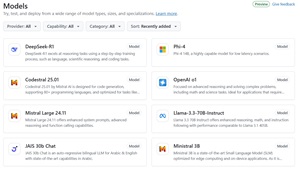 [Click on image for larger view.] GitHub Models (source: GitHub).
DeepSeek recently rocked the entire GenAI space with its new models that perform among the best while being much cheaper to produce (see "Stargate, Microsoft, and OpenAI's AI Gamble Faces Shockwaves from Chinese Breakthrough" by John K. Waters in sister pub Pure AI).
Along with the AI tech shakeup, concerns about Chinese data collection quickly arose around the world, perhaps reflecting the current geopolitical situation.
"DeepSeek, the Chinese app that sparked a $1 trillion US market meltdown this week, is storing its fast-growing troves of US user data in China -- posing many of the same national security risks that led Congress to crack down on TikTok," said a New York Post article this week. It noted the huge popularity of the new offering: "The artificial intelligence chatbot topped the charts in Apple's App Store and Google's Play Store on Tuesday. DeepSeek has been downloaded more than 2 million times since its debut on Jan. 15, with most coming in the last three days, according to AppMagic."
Meanwhile, a Bloomberg article reported DeepSeek AI was restricted by "hundreds of companies" within days of its debut.
Readers of Visual Studio Magazine, however, apparently don't need to worry about such restrictions as Microsoft and some other tech tech companies have fully embraced DeepSeek. While Microsoft was quick to park a DeepSeek model on its Azure cloud and offer dev guidance for its Semantic Kernel SDK for AI projects, Amazon and Google also provided developer access to DeepSeek models.
"DeepSeek-R1 is a 671B parameter AI model designed to enhance deep learning, natural language processing, and computer vision capabilities," GitHub said. "It offers a wide range of possibilities, provides quick insights, and allows users to explore the potential of AI in various applications."
Microsoft 's SK dev team said: "Semantic Kernel is thrilled to see such exciting development in the opensource AI community, and we think most developers are too."
Whether any organizations restrict usage of DeepSeek-powered applications created by Microsoft developers, or even if or how that could be done, remains to be seen.
About the Author
David Ramel is an editor and writer at Converge 360.