In-Depth
Mapping OpenAI's Full AI Suite After Codex CLI Debut
With OpenAI's recent introduction of Codex CLI and new foundation models, the company hearkens us back to 2021 when its Codex AI model powered the tool that helped jump-start the GenAI revolution: GitHub Copilot.
Of course, you probably couldn't pry Copilot out of the hands of Visual Studio Magazine readers nowadays, but yet another groundbreaking AI offering adds more clutter to the rapidly evolving scene. It's getting harder to keep up with what OpenAI has available now -- not to mention the general overall space -- so we've rounded up OpenAI's major products as a guide to which does what. We think .NET-centric developers might well be availing themselves of other constructs on the way to "vibe coding" so this helps sort things out.
But first, the latest.
Codex CLI
Codex CLI was introduced in an April 16 video titled OpenAI Codex CLI that featured the company's Fouad Matin from Agents Research and Romain Huet from Developer Experience who teamed up for "a first look and show how you can securely use Codex CLI locally to quickly build apps, fix bugs, and understand codebases faster." It's completely different from the Codex that powered the original GitHub Copilot -- they only share a name.
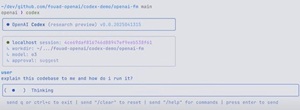 [Click on image for larger view.] Video Screen Capture of Codex CLI in Action (source: OpenAI).
"Codex is a lightweight coding agent that can run directly from your command line," explained Roma, who also said, "We're really excited to actually share Codex with you -- fully open source. You can go to our GitHub ... and we're super excited to hear what you think."
That OpenAI Codex CLI repo explains it's an experimental project under active development, not yet stable or feature-complete and possibly containing bugs.
 [Click on image for larger, animated GIF view.] Codex CLI in Animated Action (source: OpenAI).
The video revealed these highlights:
- New "full auto mode" - Codex can autonomously run and edit commands with safety via sandboxing and network disablement.
- Multimodal input support - Codex can interpret screenshots (e.g., macOS Photo Booth) and build full-featured web apps from visual context.
- Model compatibility - Works with newly launched o3 and o4 mini, with potential future compatibility for GPT-4.1.
- Fully open source - Codex CLI is available on GitHub for developers to explore, use, and extend.
The repo provides more information: "Codex CLI is built for developers who already live in the terminal and want ChatGPT-level reasoning plus the power to actually run code, manipulate files, and iterate -- all under version control. In short, it's chat-driven development that understands and executes your repo."
The repo also lists these highlights:
- Zero setup -- bring your OpenAI API key and it just works!
- Full auto-approval, while safe + secure by running network-disabled and directory-sandboxed
- Multimodal -- pass in screenshots or diagrams to implement features ✨
On the same day that Codex CLI was announced via video, OpenAI shipped GPT-o3 and GTP-o4 Mini, adding to the mix.
So Which Does What?
Here's the roundup of OpenAI's current primary offerings, notwithstanding many integrations and other projects, primarily based on OpenAI's descriptions.
| Product |
Description |
Introduced |
Specs |
Use Cases |
| Codex CLI |
Open-source terminal-based coding agent with reasoning and multimodal support. |
April 16, 2025 |
Works with GPT-4.1 family; full-auto; sandboxed execution |
Secure coding, automation, terminal-native workflows |
| GPT-o3 |
Advanced multimodal reasoning model with integrated tool use. |
April 16, 2025 |
Text, code, image inputs; seamless API tool calls |
Math, science, coding agents |
| GPT-o4 Mini |
Fast and efficient reasoning model with strong STEM and vision performance. |
April 16, 2025 |
Multimodal; optimized for latency and cost |
STEM workflows in constrained environments |
| GPT-4.1 |
Flagship model with high reasoning performance and low query costs. |
April 14, 2025 |
1M-token context; 21% better coding vs GPT-4o |
Code editing, AI agents, complex workflows |
| GPT-4.1 Mini |
Faster, cheaper GPT-4.1 variant balancing power and price. |
April 14, 2025 |
1M-token context; ~40% of GPT-4.1 cost |
Bulk tasks, AI orchestration |
| GPT-4.1 Nano |
Low-latency, affordable model ideal for real-time applications. |
April 14, 2025 |
1M-token context; $0.10M input / $0.40M output |
Chatbots, edge devices, low-cost queries |
| Text-to-Speech API |
API for generating natural and HD synthetic voices from text. |
March 20, 2025 |
$15/$30 per 1M chars (standard/HD); 4096-char limit |
Audiobooks, accessibility, assistants |
| GPT-3.5 Turbo |
Optimized chat model with broad adoption in conversational AI. |
Jan. 25, 2024 |
16K tokens; $0.002 per 1K tokens |
Chatbots, prototypes, summarization |
| GPT-4 Turbo |
High-context multimodal model for demanding workloads. |
Nov. 6, 2023 |
128K context; reduced cost vs GPT-4 |
Document processing, AI agents, longform input |
| DALL·E 3 |
State-of-the-art image generator with strong prompt-following. |
Oct. 3, 2023 |
Text-to-image; accurate text rendering |
Design, marketing, visual creativity |
| Moderation API |
Multimodal moderation model using GPT-4o for safety tasks. |
Sept. 26, 2024 |
Text + image inputs; 13 harm categories |
App filtering, content moderation |
| Whisper |
Open-source multilingual speech recognition and translation model. |
Sept. 21, 2022 |
680K hours; strong accent/noise handling |
Transcription, captioning, voice UX |
| text-embedding-ada-002 |
General-purpose embedding model for search and clustering. |
Dec. 15, 2022 |
1536-dim; $0.0001 per 1K tokens |
Semantic search, recommendations |
Of course, this will probably need updating next week or so.
About the Author
David Ramel is an editor and writer at Converge 360.