News
Vibe Coding Pioneer Advises 'Tight Leash' to Rein In AI BS
Andrej Karpathy, who started the whole "vibe coding" thing to describe AI-driven software development, is now warning developers to keep tight control of their "new over-eager junior intern savant with encyclopedic knowledge of software, but who also bull* you all the time, has an over-abundance of courage and shows little to no taste for good code." The expletive was deleted.
The OpenAI co-founder outlined a cautious, methodical workflow for AI-assisted coding that emphasizes high-context prompting, careful evaluation of multiple approaches, manual learning, and tight control over AI suggestions, seemingly contrasting it with casual vibe coding and highlighting the need for better tooling -- without using the term "vibe coding."
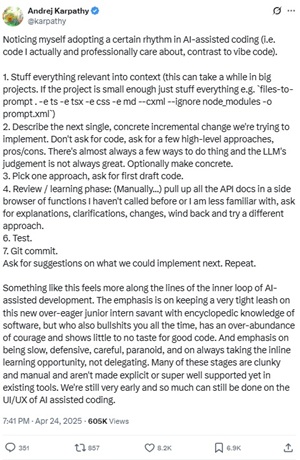 [Click on image for larger view.] A Certain Rhythm (source: X).
Here is the full April 24 tweet on a social media platform:
Noticing myself adopting a certain rhythm in AI-assisted coding (i.e. code I actually and professionally care about, contrast to vibe code).
1. Stuff everything relevant into context (this can take a while in big projects. If the project is small enough just stuff everything e.g. 'files-to-prompt . -e ts -e tsx -e css -e md --cxml --ignore node_modules -o prompt.xml')
2. Describe the next single, concrete incremental change we're trying to implement. Don't ask for code, ask for a few high-level approaches, pros/cons. There's almost always a few ways to do thing and the LLM's judgement is not always great. Optionally make concrete.
3. Pick one approach, ask for first draft code.
4. Review / learning phase: (Manually...) pull up all the API docs in a side browser of functions I haven't called before or I am less familiar with, ask for explanations, clarifications, changes, wind back and try a different approach.
6. Test.
7. Git commit.
Ask for suggestions on what we could implement next. Repeat.
Something like this feels more along the lines of the inner loop of AI-assisted development. The emphasis is on keeping a very tight leash on this new over-eager junior intern savant with encyclopedic knowledge of software, but who also bull* you all the time, has an over-abundance of courage and shows little to no taste for good code. And emphasis on being slow, defensive, careful, paranoid, and on always taking the inline learning opportunity, not delegating. Many of these stages are clunky and manual and aren't made explicit or super well supported yet in existing tools. We're still very early and so much can still be done on the UI/UX of AI assisted coding.
Karpathy started off the vibe coding craze with another tweet in February (see "AI's Takeover of Software Development Gets a Name: 'Vibe Coding'").
A Karpathy comment to his own post expresses some concern about the term vibe coding itself:
I inherited "AI assisted coding" from this @simonw post: https://simonwillison.net/2025/Mar/19/vibe-coding/
But I think it needs work. It doesn't roll off the tongue.
Few days ago a friend asked me if I was vibe coding and I said no I'm "real coding". Possible candidate :D
His tweet has 6.9K views, 8.2K likes, 852 reposts and 349 comments at the time of this writing. Here's a selection of the latter:
- Biggest challenge so far is focusing AI on the task at hand. How many times will it fix something then make problems elsewhere? We need a 'hard freeze code' function that really works. Positive: This the worst vibe coding will ever be.
- Wow, thank you. This is a fantastic way to think about breaking down the problem in a large scale project such that the LLM can a, understand the scope of the problem and b, do actually useful, incremental work. Good new tricks for us to learn. Thanks!
- Vibe coding is useful for when it's based on mature libraries. But you can't ask today's AIs to conjure up good libraries. That still in the domain of very skilled humans. In addition, designing the overall structure of the UI (even when you have good libraries) is also a human-dominated skill. Why? Innovative stuff is stuff that is out of distribution.
- This shift feels like the rise of TDD in the early 2000s. Not about tools, but about developing a mental discipline around how we interact with AI codegen.
- Vibe coding = rough plan. Real coding = well thought out and refined plan broken down as discretely as possible into manageable tasks and subtasks.
- finding that rhythm is key to maximizing ai's potential in coding.
About the Author
David Ramel is an editor and writer at Converge 360.