News
Agents Now Conduct 'Deep Research' in Azure AI Foundry Limited Preview
Microsoft has embedded OpenAI's powerful "deep research" model into Azure AI Foundry, enabling developers to build agents that don't just retrieve information -- they autonomously analyze, synthesize, and report on it. Now in public preview, the agentic capability brings research-grade reasoning to enterprise-scale workflows through programmable APIs and SDKs.
"With Deep Research, developers can build agents that deeply plan, analyze, and synthesize information from across the web -- automate complex research tasks, generate transparent, auditable outputs, and seamlessly compose multi-step workflows with other tools and agents in Azure AI Foundry," said Yina Arenas, VP of Product, Core AI, at Microsoft, in a July 7 blog post.
OpenAI introduced Deep Research on Feb. 2, 2025, as an advanced agentic feature inside ChatGPT. Unlike typical AI assistants focused on conversational speed, it was designed for methodical, multi-step investigations using real-time web browsing, source evaluation, and structured output generation. The system is powered by a version of OpenAI's o3 model, adapted for data-rich reasoning and tool use.
The capability was developed to support knowledge workers in fields like science, finance, and policy -- settings where rigor, documentation, and traceability are critical. It outputs structured reports with citations and a transparent summary of its reasoning, aimed at replacing hours of manual research with a single query-driven session.
In performance testing, the model behind Deep Research achieved 26.6 percent accuracy on Humanity's Last Exam, a challenging benchmark covering over 100 expert domains. It also reached top scores on GAIA, a standard for web-based reasoning tasks, where it demonstrated proficiency in information synthesis, source interpretation, and task planning across increasing levels of complexity.
It was early on adopted inside Microsoft 365 Copilot, where it powers the Researcher agent used for synthesizing business content across documents, chats, and emails. That implementation brought Deep Research into user-facing productivity tools, helping knowledge workers generate structured outputs grounded in both internal files and public information.
Microsoft calls Researcher a "reasoning agent" and recently paired it with the Analyst reasoning agent in Microsoft 365 Copilot. Researcher finds and synthesizes information across an organization and the web, while Analyst turns raw data into insights using advanced reasoning and code execution.
OpenAI has indicated that Deep Research is part of a broader agentic roadmap. Future plans include combining it with executional agents like Operator, enabling longer-running task automation that moves beyond information gathering into real-world action and system control. Operator was unveiled this year as research preview of an agent that can use its own browser to perform tasks for users.
In Azure AI Foundry, the preview of Deep Research is not just a productivity assistant -- but rather a programmable research engine. Microsoft has reimagined the capability as a composable agent tool, available through both SDK and API, allowing developers to embed advanced research automation directly into applications, workflows, and multi-agent systems.
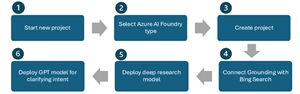 [Click on image for larger view.] The Workflow (source: Microsoft).
"Unlike packaged chat assistants, Deep Research in Foundry Agent Service can evolve with your needs -- ready for automation, extensibility, and integration with future internal data sources as we expand support," Arenas said. This makes the Azure version fundamentally different from its origin in ChatGPT: it's not an end-user interaction, but a backend capability that can be invoked, chained, and scaled across enterprise systems.
At its core, the offering is built around the o3-deep-research model. Research flows begin by clarifying intent with a GPT-4-series model, then gather source material using Bing-based web grounding before executing a multi-step research plan. The model reasons step-by-step, pivots as it encounters new findings, and delivers a structured report -- complete with citations, internal prompts, and a reasoning trail that's fully auditable.
Microsoft outlines several concrete benefits for developers and architects integrating Deep Research:
- Automated web-scale research using a best-in-class research model grounded with Bing Search, with every insight traceable and source-backed.
- Composable agents that can be invoked by apps, workflows, or other agents -- turning Deep Research into a reusable, production-ready service.
- Workflow orchestration via Logic Apps, Azure Functions, and Foundry Agent connectors to trigger downstream processes like notifications, report generation, or approvals.
- Enterprise-grade control with Azure AI Foundry's security, compliance, and observability frameworks, allowing teams to govern how research is run, who runs it, and how results are used.
Microsoft emphasizes the flexibility of the architecture: "You can trigger a research agent as part of a multi-agent chain: one agent performs deep web analysis, another generates a slide deck with Azure Functions, while a third emails the result to decision makers with Azure Logic Apps." That modularity turns Deep Research from a one-off utility into a foundational building block for intelligent systems.
Use cases for the Azure integration go beyond individual productivity. Microsoft envisions research agents powering automated market analysis, competitive intelligence, regulatory reporting, and internal knowledge synthesis at scale. Because the tool is programmable and composable, it can adapt to domain-specific logic and connect directly with enterprise data systems -- bringing deep reasoning to places where traditional search or summarization tools fall short.
Pricing for the o3-deep-research model starts at $10 per million input tokens and $40 per million output tokens, with reduced rates for cached inputs. Bing Search grounding and GPT-based scoping are billed separately. As of the preview launch, Deep Research in Azure AI Foundry is available to approved customers through limited access.
About the Author
David Ramel is an editor and writer at Converge 360.