News
Azure Vibe Coding for the Enterprise Masses: Microsoft Partners with Replit
Replit has struck a strategic partnership with Microsoft to bring its agentic, AI-powered development platform to Azure, enabling business users across enterprises to build and deploy applications using only natural language. The announcement, made July 8, positions Replit's self-described "vibe coding" experience as a native offering on Microsoft's cloud, with deep integration into Azure infrastructure and eventual availability via the Azure Marketplace.
This move marks a significant evolution in Replit's enterprise ambitions. Known originally as a browser-based IDE for student and hobbyist developers, Replit has increasingly pivoted toward what it calls "agentic software creation" -- using AI agents to turn plain-English intent into real software, complete with back-end logic, UI, and database connectivity. According to Replit, the new partnership allows enterprises to deploy this capability securely at scale, making software creation as accessible as writing a document.
"This collaboration is a significant step in breaking down traditional barriers to application development," the company said in its announcement, "by enabling employees across all departments -- not just engineering -- to build and deploy secure, enterprise-grade software using natural language."
The Microsoft pact integrates Replit with several key Azure services:
- Azure Container Apps
- Azure Virtual Machines
- Neon Serverless Postgres (Azure native)
This allows users to develop applications entirely within Replit and then deploy them to Azure infrastructure without leaving the platform. Eventually, enterprise customers will also be able to purchase Replit through the Azure Marketplace and manage deployment through either Replit-managed infrastructure or their own Azure environments. Replit also noted it is SOC 2 Type II compliant and designed for enterprise-grade security and governance.
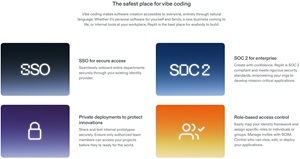 [Click on image for larger view.] Replit Vibe Coding (source: Replit).
The collaboration aligns with Microsoft's broader strategy to expand the use of AI copilots and agentic platforms across its cloud ecosystem. "Our collaboration with Replit democratizes application development," said Deb Cupp, President of Microsoft Americas, in a news release, "enabling business teams across enterprises to innovate and solve problems without traditional technical barriers."
Microsoft's decision to partner with Replit -- despite already offering advanced AI systems like GitHub Copilot and having deep ties to OpenAI -- highlights a key strategic distinction: Replit isn't just a coding assistant, it's an agentic software creation platform. While tools like Copilot assist developers inside code editors and systems like ChatGPT generate code snippets in response to prompts, Replit provides a full-stack, browser-based environment where users can go from natural language input to a deployed application without touching a traditional IDE. The platform is designed not for professional developers, but for business users -- those in sales, operations, or product roles -- who need to build internal tools or prototypes without relying on engineering teams. That end-to-end workflow, combining hosted runtimes, databases, deployment infrastructure, and real-time collaboration, makes Replit fundamentally different from coding copilots or conversational AI tools.
The partnership also represents a shift in Replit's cloud alignment. While the company previously worked closely with Google Cloud -- most notably in 2023 when it partnered with Google to bring Replit AI to developers using Google's infrastructure -- its decision to build enterprise-grade deployment features natively on Azure signals a stronger embrace of Microsoft's cloud stack, particularly in the enterprise market.
This comes amid a broader trend in developer tools and enterprise AI: a growing demand for platforms that enable "citizen developers" -- non-technical staff -- to build functional software without relying on overstretched IT or engineering teams. Replit joins a growing cohort of companies exploring the concept of AI agents that can plan, generate, and deploy software with minimal human input, complementing rather than competing with tools like GitHub Copilot, which are still largely targeted at professional developers inside code editors.
Replit CEO Amjad Masad clarified in an social media thread that the company isn't being bought out ("To be clear: we're not getting acquired 🙂 It's a big partnership that we're excited about, but Replit remains independent."). He also mentioned the possibility of future individual usage, not just enterprise. In fact, in response to user questions and comments in the thread, he provided additional insight into the partnership's impact and future plans, making for kind of an ad hoc Q&A:
CEO Masad Answers Questions
Question: What's the impact on your non-enterprise users? Do they benefit (lower pricing, increased availability, larger DB, VM size, etc.)?
Masad: Yes all the above.
Comment: Please don't forget about dummies like myself as well please. I like to call it the KISS Concept. (Keeping it super simple)
Masad: You're not dummies. You're valued customers.
Question: Does this partnership mean Replit is available within Microsoft for employees or as an enterprise cloud offering?
Masad: As enterprise offering. But we are having discussions about getting it to you!
Question: watched replit evolve from hacker playground to enterprise-grade infra -- this shift feels like the real start of ambient software creation at scale. curious how the agent handles org-specific context over time.
Masad: It's been a journey. Thanks for sticking with us.
Question: WOW, so my SaaS that I built fully on Replit is now an enterprise-level.
Masad: 💯
Comment: Nice work Replit BD team!
Masad: 👏 @Jeff_Burke14
About the Author
David Ramel is an editor and writer at Converge 360.