News
.NET Aspire 9.5 Simplifies AppHost, Expands AI Support
Microsoft announced the release of .NET Aspire 9.5, the latest update to its opinionated stack for building distributed cloud-native applications with .NET. The new version introduces improvements across the AppHost project model, AI integrations, and resource management, along with other enhancements to developer tooling and deployment.
 [Click on image for larger view.] .NET Aspire (source: Microsoft).
.NET Aspire essentially brings "application modeling" to .NET distributed systems. Instead of treating each service, container, or dependency separately, Aspire lets you describe the entire app in one model and provides the developer experience to:
- Run it consistently in local dev environments.
- Debug across multiple services.
- Deploy it reliably to cloud targets like Azure.
Here's a look at what's new, a lot having to do with AI-related features, but starting out with the AppHost project model itself.
Single-File AppHost
.NET Aspire 9.5 adds support for a single-file AppHost project. Previously, developers created a solution with multiple projects to model distributed applications. With the new option, everything can be declared in one project file, reducing boilerplate and making it easier to manage smaller applications or prototypes. According to the release notes, developers can still use the multi-project approach when it makes sense for larger solutions.
Generative AI Visualizer
The new release debuts a Generative AI Visualizer in the Aspire dashboard. The feature provides a way to inspect and visualize prompts and responses when applications integrate large language models.
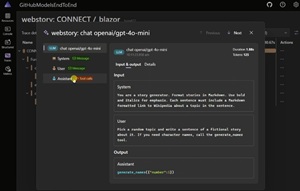 [Click on image for larger view.] GenAI Visualizer (source: Microsoft).
Microsoft said this enables developers to better understand model behavior and debug issues when working with AI-powered features.
Expanded AI IntegrationIntegration with AI services has been extended in 9.5. Typed client libraries are now available for GitHub Models and Azure AI Foundry, simplifying the process of connecting applications to hosted large language models. In addition, OpenAI support has been added to Aspire's service catalog, allowing developers to configure connections to OpenAI endpoints from within the AppHost project model.
Resource Lifecycle Improvements
Enhancements to resource management include new lifecycle hooks and health probes. Aspire now supports startup, readiness, and liveness probes that provide more granular control of resource states. These features help ensure dependent services start in the correct order and can be monitored for ongoing health once running.
Unified Logging Across Resources
Version 9.5 introduces the ability to view logs from multiple resources in a single place within the dashboard. Developers can combine logs across different components for better visibility during debugging and testing. Filtering and correlation features make it easier to trace issues through distributed applications.
Other Updates
Additional changes include new templates for AppHost and service projects, improvements to the Aspire CLI, and expanded deployment options. Publishing enhancements simplify pushing apps to Azure Container Apps, while updates to the dashboard provide more consistent views of resource health and telemetry.
Availability
.NET Aspire 9.5 is available now. Full details are provided in the announcement post and the release notes.
About the Author
David Ramel is an editor and writer at Converge 360.