News
Google Joins AI IDE Race to Compete with VS Code, Apparently Forking VS Code
Google has entered the fast-emerging category of AI-first coding environments with Google Antigravity, an agentic development platform that aims to reimagine the IDE in the era of autonomous coding assistants, appearing to be a fork of Visual Studio Code.
In a Nov. 18 announcement, the company described Antigravity as an agent-first IDE that can plan and execute end-to-end software tasks across editor, terminal, and browser surfaces, built around its Gemini 3 model and other large language models. While several outside sources have characterized Antigravity as a fork of the open-source VS Code codebase, Google has not publicly confirmed that, leaving the exact technical relationship to Microsoft's editor unclear. When asked, Google Antigravity unequivocally said it's a VS Code fork, for whatever that's worth.
 [Click on image for larger view.] Fork? (source: Ramel).
Agentic IDE with Gemini 3 at the Core
Google positions Antigravity as a response to recent gains in model intelligence for coding, saying Gemini 3 represents a step-change for agentic workflows and requires a different kind of IDE surface. The company writes that it wants Antigravity to be "the home base for software development in the era of agents," framing the product as the main environment where developers coordinate work with AI agents rather than treating them as one-off prompt targets.
 [Click on image for larger view.] Google Antigravity (source: Ramel).
The product is built around four stated tenets for collaborative development: trust, autonomy, feedback, and self-improvement. On the trust front, Antigravity focuses on exposing work at the task level instead of a stream of low-level tool calls, surfacing a "necessary and sufficient" set of artifacts and verification results that are intended to give developers confidence in agent-produced changes. As agents work, they generate artifacts such as task lists, implementation plans, walkthroughs, screenshots, and browser recordings that are meant to be easier for humans to validate than raw API traces.
 Google Antigravity Setup (source: Ramel).
Editor and Manager Surfaces
Antigravity provides two primary product surfaces. The "Editor view" presents a more traditional IDE-style experience, with an AI-powered editor that includes tab completions, inline commands, and an agent in a side panel. This view caters to developers who want to work synchronously with an embedded agent while remaining in a familiar code-editing workflow.
Complementing that is an agent-first "Manager" surface that flips the usual model of embedding agents into tools. Instead, multiple tools and workspaces are embedded into the agent's environment. Google describes this Manager view as a kind of mission control for spawning, orchestrating, and observing multiple agents working across different workspaces in parallel, enabling more asynchronous interaction patterns where background tasks run while the user focuses on other work.
The overall product form factor is designed to support agents that can operate concurrently across editor, terminal, and browser surfaces, reflecting Google's view that newer models are capable of running longer, more autonomous workflows without constant human intervention.
Feedback and Self-Improvement
To address the reality that agentic systems may complete most, but not all, of a task to a user's satisfaction, Antigravity emphasizes feedback loops. The platform starts with local operation and supports asynchronous feedback directly on artifacts, including Google Docs-style comments on text artifacts and select-and-comment mechanisms on screenshots. That feedback is incorporated into the agent's execution without requiring users to stop or restart the agent's process, allowing for incremental correction rather than all-or-nothing task runs.
On the self-improvement side, the product "treats learning as a core primitive, with agent actions both retrieving from and contributing to a knowledge base." According to Google, this knowledge management lets agents learn from past work, including explicit items such as code snippets and derived architectures, as well as more abstract items such as the series of steps used to complete specific subtasks. These accumulated knowledge items are exposed in the Agent Manager so users can see how prior work and feedback are being reused.
Public Preview, Models, and Platforms
Antigravity is available "from today" in public preview "at no charge, with generous rate limits on Gemini 3 Pro usage." The initial release targets individual developers rather than teams, though the announcement signals an intent to evolve the product as agentic workflows mature.
The platform currently supports macOS, Linux, and Windows, aligning its reach with the cross-platform footprint developers expect from modern IDEs and code editors. Inside the agent environment, Antigravity exposes multiple model options: Google's own Gemini 3, Anthropic's Claude Sonnet 4.5, and a model referred to as GPT-OSS from OpenAI, giving developers a degree of model-level choice within a single environment.
Google points readers to additional documentation and use cases to explore Antigravity's feature set and indicates that new capabilities will be shipped frequently, with updates announced through the Antigravity blog and on social channels including X, LinkedIn, and YouTube.
Fork or Not? VS Code Ecosystem Context
Antigravity arrives at a time when Microsoft itself is moving to make Visual Studio Code an open-source AI editor and to bring AI features into the core editor stack rather than confining them to extensions. That work includes plans to open source the GitHub Copilot Chat extension and refactor AI-related components into VS Code core so AI functionality can be built and extended in the same way as other parts of the editor.
Because VS Code is open source and widely forked, many recent AI-focused IDEs and coding assistants have been built on top of its permissively licensed core. Against that backdrop, some observers have described Antigravity as another entry in the growing family of AI IDEs that build on the VS Code codebase. However, Google's Antigravity announcement does not mention Visual Studio Code or Code OSS by name, and the company has not publicly confirmed whether Antigravity is a direct fork, a partial reuse of components, or an independently implemented editor that adopts similar patterns.
The two offerings are certainly similar in look, feel and functionality, putting the issue to bed as far as this reporter is concerned.
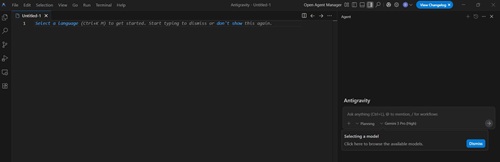 [Click on image for larger view.] Google Antigravity New File (source: Ramel).
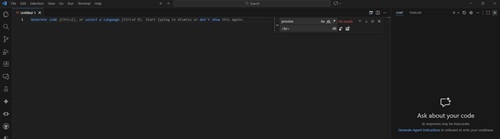 [Click on image for larger view.] VS Code New File (source: Ramel).
What It Means for VS Code Developers
For Visual Studio Code users and extension authors, Antigravity represents another high-profile validation of the agentic IDE concept that Microsoft is also pursuing in VS Code. Developers who are already comfortable with VS Code's editor model and AI integrations may find Antigravity's agent management features, cross-model support, and knowledge base capabilities notable as a different take on how AI tooling should be surfaced.
If Antigravity does turn out to be based on the VS Code codebase, it would join a growing set of AI-first tools that leverage the same open-source foundation. If not, it still competes in the same conceptual space, aiming to be the primary environment where agents and humans collaborate on complex, multi-surface software tasks. Either way, the introduction of Antigravity raises the competitive stakes in the AI IDE race and gives the VS Code ecosystem another reference point for how agentic development experiences can be packaged and delivered.
About the Author
David Ramel is an editor and writer at Converge 360.