Visual Studio Toolbox
Claude Code Edges OpenAI's Codex in VS Code's Agentic AI Marketplace Leaderboard
Among the many AI-powered coding helper extensions in the Visual Studio Code Marketplace tagged with "agent," Claude Code is now leading pioneer OpenAI's Codex coding agent.
Despite being published some three months later, Claude Code for VS Code leads Codex - OpenAI's coding agent in installs, 5.2 million to 4.9 million, and in ratings, 4 to 3.4 on a 0-5 scale, with 606 reviews for Claude and 272 for Codex.
How OpenAI Positions Codex
OpenAI describes Codex as a "coding agent" designed to help developers "write, review, and ship code faster," with two primary usage modes: working side-by-side in your editor and delegating larger jobs to run in the cloud.
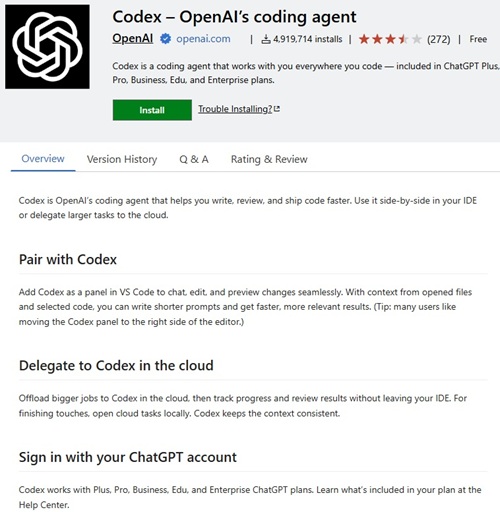 [Click on image for larger view.] Codex - OpenAI's Coding Agent (source: VS Code Marketplace).
In VS Code, OpenAI positions Codex as an in-IDE panel that can chat, edit, and preview changes using context from open files and selected code, aiming to reduce prompt length and improve relevance. OpenAI also emphasizes delegation to "Codex Cloud" for bigger tasks, with progress tracking and a workflow that brings cloud results back into the IDE for review and finishing work. Access is positioned as plan-based (tied to ChatGPT account tiers in the Marketplace description), with the IDE extension framed as one surface among several (terminal/IDE/app/cloud) for pairing or delegation.
How Anthropic Positions Claude Code
Anthropic positions Claude Code as an agentic coding tool with a strong terminal-first identity, emphasizing speed on large codebases ("search million-line codebases instantly") and compression of multi-step workflows into single commands.
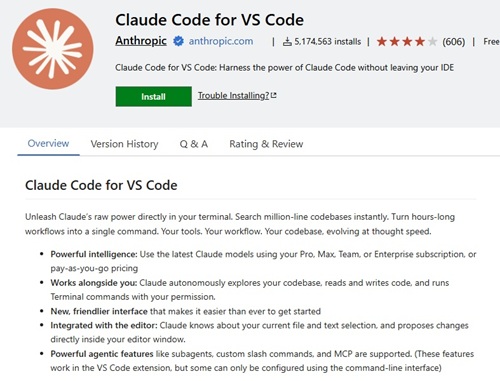 [Click on image for larger view.] Claude Code for VS Code (source: VS Code Marketplace).
Anthropic highlights autonomy with guardrails: Claude can explore the codebase, read and write code, and run terminal commands "with your permission." The Marketplace listing also foregrounds "agentic features" such as subagents, custom slash commands, and MCP support, presenting Claude Code as both an assistant and an extensible agent framework. In Anthropic's own announcement about the VS Code extension, the company frames it as a richer, graphical IDE experience (beta) with a dedicated sidebar and inline diffs so users can see changes in real time, aimed at developers who prefer IDE workflows over terminal-only operation.
What's the Buzz?
A few visible indicators suggest Claude Code has been drawing outsized day-to-day discussion among developers, even with Codex also seeing heavy use:
Common Themes in How People Talk About These Tools
When developers compare Claude Code and Codex in public forums, a few recurring themes show up:
- Limits, pricing, and how long you can stay "in flow": In the Hacker News comparison thread, multiple comments focus on practical constraints (plan limits, model availability, and session length) as factors that can outweigh pure capability in day-to-day use.
- "Agentic" workflow style: Claude Code is frequently discussed in terms of terminal-centric, command-driven routines, which aligns with how often community writeups focus on slash commands and repeatable automation.
- Tool integration as a differentiator: MCP support comes up as a selling point in Claude Code's own Marketplace positioning and in developer experimentation around connecting agents to external tools.
Security Coverage as Part of the Story
Another strand of public conversation is concern about the security implications of agentic tools that can run commands and interact with repos. For example, late-February 2026 security reporting highlighted vulnerabilities involving Claude Code workflows and risk scenarios for developer machines, with notes that fixes/mitigations were implemented. See Dark Reading coverage and SecurityWeek coverage. This kind of coverage tends to generalize to the broader category of tools that can execute actions, not just generate text.
Marketplace Momentum vs. Workflow Fit
Marketplace installs and ratings offer one snapshot of momentum in a crowded "agent" category, but they only capture what happens inside VS Code's extension ecosystem. Both OpenAI and Anthropic are positioning their products as agents that span multiple surfaces -- IDE panels, terminal workflows, and longer-running delegated tasks -- and the competitive differences often come down to workflow fit as much as model capability.
For developers and teams evaluating these tools, the practical questions tend to be less about which extension is on top in a given week and more about which agent best matches their day-to-day loop: how much autonomy they want to grant, how changes are reviewed, how tools are integrated, and how risk is managed when an assistant can execute actions instead of only generating text.
Notes on the Comparison
Note that this comparison only focuses on tools tagged with "agent," which is generally up to the discretion of the publisher. There are many other coding assistants in the Marketplace that may not be tagged as agents but still have significant adoption and agentic AI capabilities.
For example, as might be expected, GitHub Copilot is the granddaddy of them all, boasting nearly 72 million installs. Still described as the original "AI pair programmer," it just wasn't adorned with an "agent" tag, though it certainly facilitates agentic AI workflows in practice. Interesting side note on that: GitHub just today announced "Claude and Codex now available for Copilot Business & Pro users."
The comparison also doesn't capture usage patterns outside of the Marketplace, such as terminal-only workflows or cloud-based delegation, which are important parts of how these tools are positioned and used.
About the Author
David Ramel is an editor and writer at Converge 360.