Espresso Logic Back-End Service Adds Azure Integration
The Espresso Logic Backend as a Service (BaaS) that can "join" SQL and NoSQL database calls now integrates with Microsoft Azure, the company announced yesterday.
The tool, which lets developers span multiple data sources with one RESTful API call via a point-and-click interface, now works with SQL Server, MongoDB and other services available on the Microsoft cloud.
The Silicon Valley startup last month announced its reactive programming-based universal API for "joining" calls to SQL and MongoDB databases, for example, while also providing the ability to apply business logic, authentication and access control, and validation and event handling to specific data stores.
"Espresso provides the fastest way to create REST APIs that span multiple data sources including SQL, NoSQL and enterprise services," the company said. "Using a unique reactive programming approach, Espresso enables developers to write clear and concise business rules to define logic and specify fine-grain security in a fraction of the time it takes using other approaches."
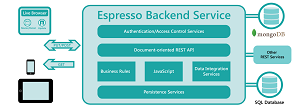 [Click on image for larger view.]
The Espresso Logic Approach(source: Espresso Logic Inc.)
[Click on image for larger view.]
The Espresso Logic Approach(source: Espresso Logic Inc.)
Reactive programming is a declarative approach in which variables are automatically propagated through the system when referenced values are changed, as in a spreadsheet where cells that contain a formula to present a value are automatically updated when values in dependent cells are changed.
"With reactive programming business rules, any rules defined on business objects perform many types of calculations and validations," the company said. Developers can further extend the logic using JavaScript.
The Espresso service previously worked with Azure SQL Database as a cloud-hosted database, but is now available as a service hosted in Azure and integrated with other Microsoft cloud services.
Espresso says its RESTful BaaS integrates with Visual Studio and Microsoft's own back-end, Azure Mobile Services, accelerating the development of mobile and Web apps. It can also work with other Microsoft technologies such as Azure Active Directory identity and authentication, Microsoft Dynamics, Azure Scheduler, Message Bus and API Management tools.
"As many enterprise customers using Microsoft technologies move to using cloud, we hear time and time again that Azure support is high on their list," said company CEO R. Paul Singh in a statement. "With this integration, we want to make it easier and faster for enterprises and integrators developing new mobile and Web applications on Azure -- regardless of their data source."
The Espresso service is available for a free trial, with a paid developer version costing $50 per month and a production version starting at $500 per month.
Posted by David Ramel on 09/18/2014