News
Triplebyte Charts 'The Rise of Visual Studio Code'
Technical hiring specialist Triplebyte, noticing a huge upsurge in the use of Visual Studio Code during its hands-on programming interviews, dug into its data trove to learn more.
It found some interesting correlations, for which causality is hard to prove in such studies, but one thing is certain: Visual Studio Code is on the rise.
"Visual Studio Code usage is rising rapidly!" says a recent company blog post. "VS Code is now the editor chosen by the majority of engineers during programming interviews, and it appears to be rapidly taking market share from other top editors."
Triplebyte says it aims to help programmers find great companies to work for, mainly through a rigorous technical interview process that it uses to find the top coding talent, who can perhaps get a leg up on the resume screening process at companies that partner with the firm.
Conducting hundreds of engineer interviews each week, the company records the editor, language and operating system used by the candidates. "It gives us insight into which tools different cohorts of engineers prefer, and how these preferences change over time. It also allows us to identify correlations between the tools engineers choose and their performance during programming interviews."
An employee last year did some data mining to gauge "Technical Interview Performance by Editor/OS/Language," but, having experienced much growth in a year, the firm decided to revisit the study this year.
That resulted in last week's post, "The Rise of Microsoft Visual Studio Code."
Diving into the data on the editors used during all interviews conducted over the last year resulted in this breakdown:
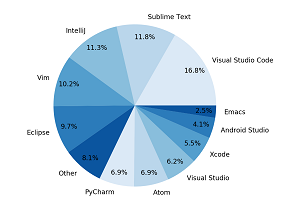 [Click on image for larger view.] Editor Usage Rates (source: Triplebyte).
"The first thing that jumps out from this graph is the prominence of Visual Studio Code," the company said. "With 17 percent of the pie, VS Code was the editor used by the plurality of Triplebyte candidates last year. This was a surprise to me for two reasons. First, VS Code is a relatively new product from Microsoft, and, second, last year it didn't even appear on our charts -- its share was small enough to fall into the 'other' bucket."
The authors (Lyn Levenick and Ammon Bartram) go on to slice and dice the data in different ways, exploring which editors are used by the best programmers, interview pass rates based on the programming language used, editor usage by language, and more, factoring in other criteria such as levels of experience, location and more.
Finally, they reached some conclusions:
- Visual Studio Code is on the rise. Over the past year, it has become the most popular editor across the board, and it's gaining ground every month. I wonder if the editor landscape is experiencing a tectonic shift, from a relatively fractured market to a world in which a single editor has over 50 percent of the market?
- Engineers who use old school editors like Vim or Emacs tend to be strong programmers. That said, this finding may be best explained by the fact that these editors are especially popular among more experienced engineers.
- Engineers who use Go are also especially strong. If you know why, please let me know.
- Engineers who use Eclipse or Visual Studio do less well (on average) in our interviews. This correlation still stands for interviews with external companies who use our platform.
The final conclusion, however, casts doubt on all of the above.
"Take all of this with a grain of salt," the post concluded. "I want to end by saying that we don't think any of this is causative. That is, I don't recommend that you start using Emacs and Go (or stop using Eclipse and Java) on the basis of this data. There are strong programmers who use every set of tools. The most important thing in any interview is using the tool that you are most comfortable with."
The increasing popularity of VS Code isn't new, though. For example, in its huge Octoverse report on the open source coding scene, GitHub found that VS Code this year repeated as the top open source project, based on the number of contributors. Earlier this year another huge developer survey, conducted by Stack Overflow, found VS Code was the most popular developer environment tool.
To see the developer discussion about Triplebyte's new study, see the posts on Reddit and Hacker News.
About the Author
David Ramel is an editor and writer at Converge 360.