News
Survey: More C# Coders Targeting .NET Core
The young .NET Core, an open source, cross-platform alternative to .NET Framework, is increasingly becoming the runtime target choice for C# coders, according to new survey results published by JetBrains.
.NET Core was initially released two years ago this month, but really picked up steam with last year's launch of .NET Core. 2.0 and .NET Standard 2.0, the latter of which unifies APIs available to all .NET implementations.
Microsoft advises that .NET Core be used for certain specific projects -- including highly scalable Web apps, Web apps on Linux or self-contained deployments -- while .NET Framework remains the best option for Windows-only projects.
However, the JetBrains State of Developer Ecosystem in 2018 survey shows a definite uptick in .NET Core targeting since last year, perhaps reflecting the continuing opening up of Microsoft-centric developer tooling to encompass other platforms and systems.
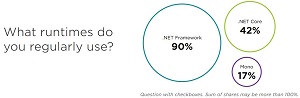 [Click on image for larger view.] Regularly Used Runtimes in 2018 (source: JetBrains).
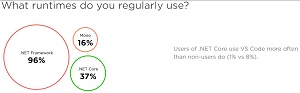 [Click on image for larger view.] Regularly Used Runtimes in 2017 (source: JetBrains).
The C# section of this year's survey shows 42 percent of respondents regularly use .NET Core, compared with 90 percent for .NET Framework and 17 percent for Mono. Last year, it was .NET Core, 37 percent, .NET Framework, 96 percent, and Mono, 16 percent.
So .NET Core's share went up at the expense of .NET Framework, climbing 5 percentage points, while .NET Framework dropped 6 and Mono dropped 1.
The survey also further reflected the increasing branching out of C# coders from their traditional Windows roots. "C# developers are spreading over to other operating systems: 6 percent of them now use macOS as a development environment, while 4 percent work on Unix/Linux," the survey report said.
Other survey results showed little change from last year's findings, as the top three technologies/frameworks used remained ASP.NET MVC, Entity Framework and ASP.NET Core, though ASP.NET Web Forms dropped from fourth to sixth place, falling from being used by 38 percent of respondents to 24 percent this year.
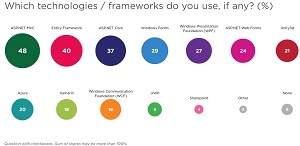 [Click on image for larger view.] Regularly Used Frameworks in 2018 (source: JetBrains).
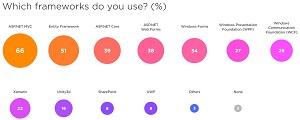 [Click on image for larger view.] Regularly Used Frameworks in 2017 (source: JetBrains).
Other highlights of the C# section of JetBrains' big survey include:
- Developers are gradually moving from C# 6 to C# 7: the share of the former dropped by 19 percent while the latter has grown by 16 percent compared to 2017.
- 59 percent of C# developers do not hold an MSDN subscription.
- Developers prefer not to use collaboration tools from Microsoft: 59 percent of them do not use Microsoft TFS or VSTS. Meanwhile, TFS has the upper hand in this internal competition with VSTS: 22 percent vs. 12 percent.
- In addition to their current toolset, C# devs are learning JavaScript (29 percent), Python (26 percent), and TypeScript (22 percent).
- As might be expected, Visual Studio's built-in performance and diagnostic tools are the overwhelming choice, with dotTrace, dot Memory and others following (behind "None," reported by 32 percent of respondents).
- NUnit was the leading unit-testing framework, mentioned by 42 percent of respondents, followed by MSTest/Visual Studio Unit Testing Framework (38 percent), xUnit (22 percent), MSTest V2 (8 percent), Other (1 percent) and None (21 percent).
In the main section of the survey, which garnered responses from some 6,000 developers early this year, Java remained the most popular primary programming language, while JavaScript was most used overall and Go was identified as the most promising language. You can read more about that and other findings at our sister site, ADTMag.
About the Author
David Ramel is an editor and writer at Converge 360.