News
Rust Survey: VS Code is No. 1 Editor
Rust has become a hot programming language lately, even being considered as a safer alternative to C/C++ by Microsoft's security team.
So what is the No. 1 editor/IDE for "Rustaceans," whose favorite language has dominated the "most loved" rankings lately (four years running) in Stack Overflow's huge developer surveys?
That would be Visual Studio Code, which isn't too surprising since Microsoft's open-source, cross-platform code editor has been named the No. 1 development tool overall in another huge developer survey, this one the GitHub Octoverse report.
This data comes in survey results published this week on the Rust Blog. The Rust team conducted a survey available in 14 different languages, garnering nearly 4,000 responses.
Of special interest to .NET-centric developers (even though Rust may be unlikely to replace C/C++ among Microsoft developers) is that VS Code was the No. 1 editor, reportedly used by about 35 percent of respondents, ahead of Vim (24 percent) and IntelliJ (21 percent).
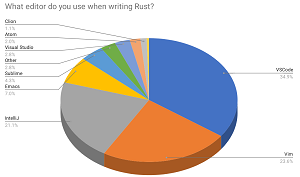 [Click on image for larger view.] Top Editors (source: Rust Team).
Microsoft's full-fledged flagship IDE, Visual Studio, meanwhile, garnered 2.8 percent of responses, placing it only above Clion and Atom.
Other highlights of the survey include (percentages rounded off):
- The most popular IDE setups used were: RLS (43 percent), IntelliJ (22 percent), Rust-analyzer (15 percent).
- Linux (55 percent) was the top OS used for Rust development, followed by Windows (24 percent) and macOS (23 percent).
- Linux was also the most popular platform targeted by Rust developers (37 percent), followed by Windows (16 percent) and macOS (15 percent). Newcomer WebAssembly was close behind macOS.
- In terms of interoperability with Rust, when respondents were asked what other languages they would like to use with Rust, C was the top answer (23 percent), followed by R and C++, grouped close together. Microsoft's C# language was way down the list, ahead of only Haskell and Swift.
The survey also sought to gauge Rust developers' views on adoption, documentation, outreach, learning curves and more.
The Rust team concluded its post with this: "Overall our users indicated that productivity is still an important goal for their work (with or without using Rust). The results show the overriding problem hindering use of Rust is adoption. The learning curve continues to be a challenge -- we appear to most need to improve our follow through for intermediate users -- but so are libraries and tooling."
As far as the aforementioned notion about Microsoft replacing C/C++ code with Rust for low-level Windows development because of security issues surrounding memory usage, the Microsoft Security Response Center (MSRC) team has said "we think the Rust programming language is currently the best choice for the industry to adopt whenever possible due to its ability to write systems-level programs in a memory-safe way." The idea is explored in a series of blog posts on the MSRC site. The most recent post was published last November, in which Adam Burch, a software engineer on the Hyper-V team, said:
I've been tasked with an experimental rewrite of a low-level system component of the Windows codebase (sorry, we can't say which one yet). Instead of rewriting the code in C++, I was asked to use Rust, a memory-safe alternative. Though the project is not yet finished, I can say that my experience with Rust has been generally positive. It's a good choice for those looking to avoid common mistakes that often lead to security vulnerabilities in C++ code bases.
About the Author
David Ramel is an editor and writer at Converge 360.