News
New Preview of WinUI 3, Native UI Platform of Windows, Fixes Stuff
Microsoft shipped preview 2 of WinUI, the UI framework that uses Fluent Design to provide a native user experience (UX) framework for both Windows Desktop (Win32) and Universal Windows Platform (UWP) applications, focusing on stability and bug fixes.
While helping developers with modern controls and styles to create application UIs that feel natural across all Windows devices, "It provides a way to gradually migrate existing apps written in familiar technologies like MFC, WinForms, and WPF, allowing you to move these applications forward at your own pace," the WinUI site states. "It also supports familiar languages spanning C++, C#, Visual Basic, and even Javascript via React Native for Windows."
In March, Microsoft launched a new web site for the project, when WinUI was offered in beta.
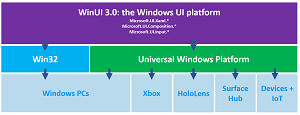 [Click on image for larger view.] WinUI 3 (source: Microsoft).
With a scheduled delivery time-frame of "2020," the goals sought in WinUI 3.0 include:
- full UI stack now decoupled from the OS
- removing barriers between UWP and Win32 (desktop): works with both
- support .NET 5 and C++
- backward-compatible on Windows 10
However, preview 2, announced July 15, doesn't do much to advance those goals.
Rather, "WinUI 3 Preview 2 was a quality and stability-driven release," Microsoft said. "It builds directly on Preview 1 by fixing quite a few critical and serious bugs that didn’t make the cut in time for our release at Build 2020 two months ago. The team wanted to put together a small release post-Build to make sure that WinUI 3 is stable and easy to use for everyone."
However, it's still not ready for use by everyone in production apps.
Microsoft said some notable additions and fixes in this release include:
- INotifyCollectionChangedand INotifyPropertyChanged are now working in C# Desktop apps
- WinUI 3 Preview 2 is now compatible with .NET 5 Preview 5 for Desktop apps
- Point, Rect, and Size members are now Double-typed in the C# projection of the APIs for Desktop apps
- Crash fixes for Input Validation and other text scenarios
More information is provided in the release notes.
About the Author
David Ramel is an editor and writer at Converge 360.