News
Visual Studio Codespaces Consolidates to GitHub Codespaces
Microsoft caused Codespaces confusion after it renamed its Visual Studio Online offering "Visual Studio Codespaces" and subsequently GitHub, owned by the company, introduced its own Codespaces.
That confusion is being addressed with today's announcement that Visual Studio Codespaces is consolidating into GitHub Codespaces.
Microsoft announced a public preview of Visual Studio Online ("cloud-hosted dev environments accessible from anywhere") last year.
"Visual Studio Online provides managed, on-demand development environments that can be used for long-term projects, to quickly prototype a new feature, or for short-term tasks like reviewing pull requests," Microsoft said. "You can work with environments from anywhere using either Visual Studio Code, Visual Studio IDE (in private preview), or the included browser-based editor."
It was then revamped and renamed Visual Studio Codespaces earlier this year amid the remote development surge caused by the COVID-19 pandemic.
Shortly thereafter, GitHub announced its own Codespaces, a fully featured, cloud-hosted dev environment -- "the full Visual Studio Code experience" -- directly within GitHub, a software development platform and code repository with an open source focus.
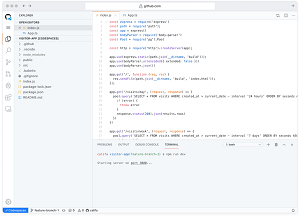 [Click on image for larger view.] GitHub's Codespaces (source: GitHub).
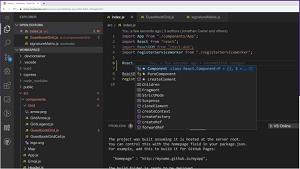 [Click on image for larger view.]
Visual Studio Codespaces
[Click on image for larger view.]
Visual Studio Codespaces
Both used the same underlying technology.
Now, today, (Sept. 4), Microsoft said:
During the preview we've learned that transitioning from a repository to a codespace is the most critical piece of your workflow and the vast majority of you preferred a richly integrated, native, one-click experience. Since GitHub is the home of 50M developers, it made sense to partner with them to address this feedback. However, after the GitHub-native experience was released, we started hearing that the two distinct experiences were causing confusion amongst our users.
We believe that by consolidating the current Codespaces experiences into one, we can eliminate confusion, simplify the experience for everyone, and make more rapid progress to address customer feedback.
Existing Visual Studio Codespaces users can start transitioning to GitHub Codespaces now; the current Azure offering will be retired in February 2021. Other developers can request access to the GitHub Codespaces limited public beta.
So the company quashed confusion with Codespaces consolidation.
Right?
About the Author
David Ramel is an editor and writer at Converge 360.