News
Google Cloud Functions Supports .NET Core 3.1 (but not .NET 5)
Google Cloud Functions -- often used for serverless, event-driven projects -- now supports .NET, but the new support is a release behind Microsoft's latest .NET offering.
On Nov. 19, Google announced support for .NET Core 3.1 in its Function-as-a-Service (FaaS) platform, but that was more than a week after Microsoft shipped the GA version of .NET Core 3.1's successor, .NET 5.
Cloud Functions helps users create single-purpose, stand-alone functions that respond to events such as user interactions or triggers, with the provider taking care of managing servers and runtime environments.
"With Cloud Functions for .NET, now in Preview, you can use .NET Core 3.1 to build business-critical applications and integration layers, and deploy the function in a fully managed environment, complete with access to resources in a private VPC network," Google said. ".NET functions scale automatically based on your load. You can write HTTP functions to respond to HTTP events, and CloudEvent functions to process events sourced from various cloud and Google Cloud services including Pub/Sub, Cloud Storage and Firestore."
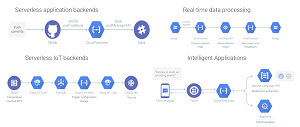 [Click on image for larger view.] Google Cloud Functions (source: Google).
In addition to C#, coders can use F# and Visual Basic to write cloud functions, in conjunction with the Functions Framework for .NET, an open source FaaS framework for creating portable .NET functions. "With Functions Framework you develop and run your functions locally, then deploy them to Cloud Functions, or to another .NET environment," Google said."
That framework includes a template package for use from the command line or Visual Studio, and the templates support VB and F# also.
With the new .NET support for serverless computing, Google Cloud is somewhat catching up to industry leader Amazon Web Services (AWS), which has supported .NET in its AWS Lambda offering for years.
The other "Big 3" cloud provider, Microsoft Azure, naturally supports .NET in its serverless offering, Azure Functions, though .NET Core 3.1 support only arrived in January.
For working with the new .NET Core 3.1 support in Cloud Functions, Google published a .NET Quickstart and pointed to "A Tour of the .NET Functions Framework" written by Jon Skeet.
About the Author
David Ramel is an editor and writer at Converge 360.