News
Azure Functions Boosted with .NET 7 Support
Azure Functions, Microsoft's serverless cloud computing offering, is previewing new functionality coming with its new support of .NET 7 as a runtime.
"For those customers who are looking into building serverless functions in Azure with the latest innovation from .NET runtime, this makes it possible for all developers on the planet to focus on coding with .NET 7 new features, ready-to-code while on a large scale without worrying about the underlying infrastructure," Microsoft's Melony Qin announced last week.
That new support brings the ability to build serverless applications with .NET 7 (currently in Preview 6) in Azure Functions using the .NET Isolated Worker model.
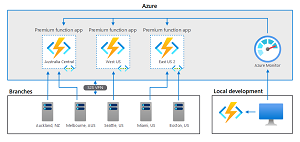 [Click on image for larger view.] Azure Functions in a Hybrid Environment (source: Microsoft).
Running in a .NET isolated process brings benefits beyond the existing tightly integrated model for .NET functions, which run as a class library in the same process as the host. The .NET Isolated Worker decouples that tight integration, separating function code from the Azure Functions runtime. Along with providing flexibility in the choice of .NET versions to work with, Microsoft says isolated process approach results in benefits such as:
- Fewer conflicts: because the functions run in a separate process, assemblies used in your app won't conflict with different version of the same assemblies used by the host process.
- Full control of the process: you control the start-up of the app and can control the configurations used and the middleware started.
- Dependency injection: because you have full control of the process, you can use current .NET behaviors for dependency injection and incorporating middleware into your function app.
"The isolated worker model also allows you to use current .NET behaviors for dependency injection and incorporating middleware into your function app," Qin said. "Choose the isolated model if you're upgrading from .NET 5 Azure functions v3."
The .NET Isolated Worker model is available for preview in all Windows-based plans, Linux dedicated and premium plans, with a Linux consumption plan to be added later.
In May, Microsoft announced the same isolated worker model support for the old .NET Framework (precursor to the open source, cross-platform "Core" .NET versions that evolved into just .NET 5, .NET 6 and so on.).
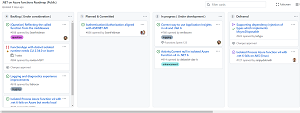 [Click on image for larger view.] .NET on Azure Functions Roadmap (source: Microsoft).
Going forward, the .NET on Azure functions roadmap shows various items and initiatives in different stages. In the public preview (dev/test) stage -- along with the isolated worker support announced for .NET 7 and .NET Framework -- are Durable Functions support in .NET Isolated worker and .NET 7.0 support isolated for AF v4. Other items in their respective stages are presented below (along with links for more information).
- Planned & Committed:
-
In progress (Under development):
-
Delivered:
- Backlog (Under consideration):
"We're looking forward to hearing your feedback and your use cases, please feel free to share them on announcement related discussions here," Qin said. "Also, if you discover potential issues, please record them on the Azure Functions .NET language worker GitHub repository."
About the Author
David Ramel is an editor and writer at Converge 360.