News
New Tool Helps Migrate On-Premises .NET Apps to Azure Cloud
Microsoft announced a new tool as part of its Azure Migrate initiative that helps developers move their on-premises .NET apps to the Azure cloud.
Debuting with the unwieldy moniker "Azure Migrate application and code assessment tool for .NET" (shortened to AppCAT), it helps developers assess a .NET app's code, configurations and binaries to smooth the migration process, adding to the Azure Migrate functionality announced way back in 2017.
"It helps to discover any issues your application might have when it is ported to Azure and improve the performance, scalability, and security by suggesting modern, cloud-native solutions," said Olia Gavrysh, senior product manager for .NET, in a Jan. 3 announcement.
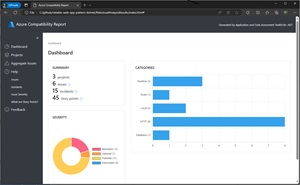 [Click on image for larger view.] Azure Compatibility Report (source: Microsoft).
AppCAT is delivered via both a Visual Studio extension and a .NET CLI tool for command-line operations. All you need for the extension is Windows and VS 2022 v17.1 or later, while the CLI tool requires installation of the .NET SDK.
The tool works with C# and Visual Basic code, supporting the older ASP.NET and newer ASP.NET Core along with class libraries. It can be used with all .NET frameworks, even the pre-Core .NET Framework. As far as Azure targets, it can find potential issues when moving to Azure App Service, Azure Kubernetes Service (AKS) and Azure Container Apps (ACA).
The detailed announcement post shows how to install both tools and use them to analyze results, after which you can interpret the results with the help of the "Interpret the analysis results" guide.
Going forward, the dev team is focusing on infusing AI functionality and providing Copilot integration, which Gavrysh said can help with overall migration as well as fixing particular issues.
"Another big feature that we are currently working on is to get you a more curated assessment based on the Azure target you choose," she said. "We plan to add the ability to set the target before the report and build the report based on that target."
More information can be found in AppCAT documentation titled "Assess your .NET applications for migration to Azure."
About the Author
David Ramel is an editor and writer at Converge 360.