News
Oh Data! Microsoft Ships First Major OData Update in Nearly 8 Years
Microsoft today shipped a preview of OData .NET 8. The last major update, coming in the Microsoft.OData.Core NuGet package, was version 7.0, which was released in August of 2016.
OData, short for Open Data Protocol, is a standardized protocol for creating and consuming RESTful APIs, allowing for the querying and updating of data using HTTP commands and integration with various data services.
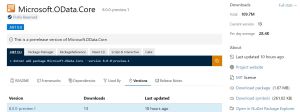 [Click on image for larger view.] OData .NET 8 Preview 1 (source: Microsoft).
"It has been almost 8 years since the last major release of OData .NET core libraries," said Microsoft's Clément Habinshuti in a post today (April 26) announcing OData .NET 8 Preview 1. "This release presents an opportunity for us to modernize our stack, address some technical debt and take better advantage of investments in .NET. To make adoption and upgrading to the new version smooth, we have opted to limit the number of breaking changes."
Of course, data technology (and every technology) has changed a lot since 2016, so breaking changes are hard to avoid. Thus today's post lists 15 breaking changes for the Core component, with others listed for the Client and other components.
The "most disruptive" change is moving on from the .NET Framework to .NET 8 and later.
"We understand that there are still a lot of people using .NET Framework," Habinshuti said. "For this reason, we will continue to maintain OData .NET v7 suite of libraries for the foreseeable future. We currently have no plans to drop support for OData Core 7.x. We will eventually stop adding new features after the 8.0 major release."
Planned changes for the Core component include:
- Make
ODataUtf8JsonWriter the default JSON writer implementation.
- Use
ValueTask<T> instead of Task<T> for async I/O operations where applicable.
- Allow customers to include custom annotations in the payload that are not included in the
include-odata-annotations preference header.
- When writing the
Scale attribute in XML CSDL, write variable in lowercase instead of Variable.
- Change the
ODataLibraryCompatibility enum into a flags enum where each bit will represent a different compatibility setting that can be used to enable some legacy serialization behavior.
- Remove deprecated APIs and behavior flags.
A Microsoft 2022 DevBlogs post unveiled a next-generation OData offering called OData.Neo. It shows no published releases, though work on the project appears to have been done as recently as February.
About the Author
David Ramel is an editor and writer at Converge 360.