News
OData Finally Ditches Old .NET Framework
Microsoft finally ditched the old .NET Framework from its OData protocol for web service APIs, shipping the first major update in eight years for .NET along with ASP.NET Core OData 9 for the company's web-dev framework.
First introduced way back in 2007, OData (Open Data Protocol) is a standard for building and consuming RESTful APIs. It's been used in various Microsoft products and has been approved by standards organizations, including Organization for the Advancement of Structured Information Standards (OASIS).
However, the project apparently ran into some headwinds, and OData .NET 8 was released last month following the last major update, version 7 of the Microsoft.OData.Core NuGet package, released in August 2016.
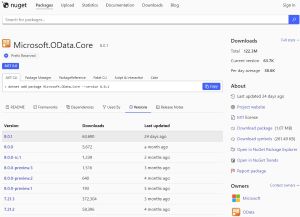 [Click on image for larger view.] OData 8.0.1 (source: Microsoft).
"The most disruptive change we are making in this release is dropping support for .NET Framework," said Microsoft in an Aug. 12 post announcing Odata .NET 8. "The new release will only support .NET 8 and later. To learn more about supported OData libraries and .NET frameworks, visit out support policy." Microsoft officially stopped active development on the proprietary, Windows-only .NET Framework in 2020, with the last version being 4.8 before the open-source, cross-platform "Core" series took hold.
Just a couple weeks ago, Microsoft announced the official release of ASP.NET Core OData 9. The company said the purpose of that post was to explore how some of bedrock version 8 changes affect the ASP.NET Core OData library, and how to toggle the legacy behavior where possible. Again, the news here is updating dependencies: "The major highlight of this release is the update of the OData .NET dependencies to the 8.x major version. By updating the dependencies, we're able to take advantage of the improvements and new capabilities introduced in Microsoft.OData.Core 8.x and Microsoft.OData.Edm 8.x releases specifically."
As indicated, OData is delivered via various NuGet packages, including:
Besides the change to the target framework, other notable changes listed in the release notes concern a new default JSON writer, a changed ODataResource.Properties property type, removal of the ODataSimplifiedOptions class and various other tweaks across the packages.
The ASP.NET Core post, meanwhile, discusses modifications such as uppercase letters for unicode code points, changes to injection of dependencies, backward compatibility flags and more. Feedback on the ASP.NET Core version can be provided at the project's GitHub repo.
The main project's GitHub issues, meanwhile, are here. The repo shows it's used by more than 40,000 other projects and lists 108 contributors.
The NuGet site shows version 7, from 2018, boasted more than 29 million downloads, while the 24-day-old version 8.0.1 has been downloaded nearly 64,000 times. Total downloads of the project now number more than 122 million.
About the Author
David Ramel is an editor and writer at Converge 360.