News
GitHub Tops AI Coding Assistants Report, with Microsoft-Related 'Cautions'
Microsoft-owned GitHub pioneered the AI coding assistant space in 2021 with the introduction of Copilot, based on a large language model (LLM) called Codex derived from OpenAI's GPT-3, and a new Magic Quadrant report from research firm Gartner shows that it continues to lead the market.
In the newly released Magic Quadrant for AI Code Assistants report, Gartner described the pioneer like this: "GitHub remains a Leader in this Magic Quadrant, with its flagship product (GitHub Copilot) focused on enhancing developer productivity across the software development life cycle. Copilot offers AI-driven code completion, generation and translation, runtime awareness (i.e., analysis of code behavior during execution), context enrichment, and automated documentation using models from Anthropic, Google, and OpenAI. GitHub serves a global client base of 77,000 enterprises, with 20 million GitHub Copilot users. It continues to invest in Copilot's agentic capabilities like Agent Mode for autonomous tasks and intends to embed AI throughout developer workflows."
However, the evaluations include "strengths" and "cautions," and under the latter for GitHub is negative commentary related to some Microsoft sales practices or frictions -- the only times in the entire report that Microsoft is mentioned:
- Sales Execution/Pricing: Despite leveraging Microsoft's substantial sales infrastructure, customers frequently encounter complexity and confusion in pricing structures related to Microsoft contractual arrangements. The multiplicity of SKUs (Copilot Free, Pro, Pro+, Business and Enterprise) and the interaction with GitHub Enterprise subscriptions contribute to perceived opacity and potential cost surprises for customers.
- Sales Strategy: GitHub's sales strategy includes Microsoft-driven sales channels. While beneficial in scale, the complexity of cross-platform pricing strategies create friction for customers seeking clear and direct negotiation paths, especially when differentiating between GitHub and Microsoft contractual terms.
The AI Coding Assistant Market
While the Copilot evaluation is of more interest to readers of Visual Studio Magazine, the broader AI coding assistant market is rapidly evolving, Gartner indicates, with various players vying for dominance. As organizations increasingly adopt AI-driven tools to enhance developer productivity, the competitive landscape is likely to shift, presenting both challenges and opportunities for established and emerging vendors alike.
"The AI code assistant market continues to burn hot as rapid innovation and intense competition is fueled by disruptive advances and new entrants," the report said. "Use this research to compare vendors, navigate key trends, and select the right AI code assistant to enhance developer productivity, foster creativity, and enable robust, contextual software development workflows."
As can be seen, the other "Leaders" include Amazon, Cognition (Windsurf), GitLab and Google Cloud.
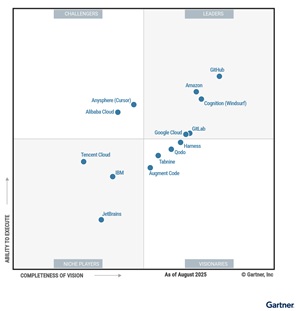 [Click on image for larger view.] 2025 Magic Quadrant for AI Code Assistants (source: Gartner).
For comparison, here's last year's Magic Quadrant for AI Code Assistants:
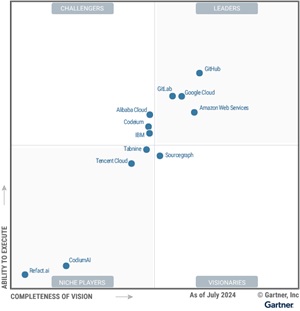 [Click on image for larger view.] 2024 Magic Quadrant for AI Code Assistants (source: Gartner).
While the leaders haven't changed that much, the space itself has seen a remarkable acceleration of new features, functionality and capabilities in the year between reports. Here's what Gartner has to say about the state of things today.
Strategic Planning Assumptions
Gartner forecasts widening enterprise adoption of AI coding assistants. The report states that "by 2027, 80% of software engineering leaders will consider prompt (or context) engineering a highly important skill to deliver software that meets the business needs of their organizations, up from 20% in 2024." It also predicts that "by 2028, 90% of enterprise software engineers will use AI code assistants, up from less than 14% in early 2024." In aggregate, Gartner expects "a 30% productivity gain in software development" across enterprises through 2028 as multiple AI-powered tools are applied across the software development life cycle.
Market Definition and Core Capabilities
Gartner defines AI code assistants as tools that generate and analyze software code and configuration using foundation models such as large language models and program-understanding technology. Developers use them to generate, analyze, debug, test, fix, refactor, document, translate, and review code, as well as to search dependencies, update libraries, understand codebases, upgrade versions, and review commits.
These assistants integrate with IDEs, terminals, chat interfaces, project management tools, monitoring/logging, and deployment tools, and some are customized to an organization's codebase and documentation.Mandatory features now include context-aware multiline completion, unit test and documentation generation, broad language/framework coverage, enterprise context awareness, an IDE-integrated conversational chat interface, assurances that base models are not trained on customer code, enterprise administration controls, and multiple deployment options (SaaS, on-premises, or private cloud).
Common differentiators include multifile edits from chat, code quality scanning and vulnerability detection, terminal command completion, enterprise fine-tuning on proprietary data, adaptive personalization, developer intent prediction, specialized agents for complex tasks, deep DevOps integrations, support for the Model Context Protocol (MCP), configurable AI guardrails, open-source code attribution, and support for multiple natural languages.
Guidance for Enterprise Adoption
Gartner recommends that software engineering leaders form a cross-functional task force spanning engineering, architecture, security, and legal to evaluate, pilot, and govern AI assistant adoption. After shortlisting vendors using the Magic Quadrant analysis, organizations should run pilots and measure results with recognized frameworks such as DORA and SPACE to track satisfaction, performance, activity, collaboration, efficiency, and flow.
Adoption friction is a recurring issue: Gartner notes that "often, less than half -- and sometimes fewer than a third -- of purchased licenses see active use after several months." To mitigate this, the report recommends role- and team-specific training, peer learning, and partnering directly with developers in tool selection to align with day-to-day needs. Gartner also highlights a skills-experience paradox for junior developers and urges structured upskilling so AI complements, rather than replaces, foundational software engineering competencies.
Market Overview
Gartner estimates the 2025 AI code assistant market at $3.0 billion to $3.5 billion, with rapid growth accompanied by volatility driven by competitive pressures and the influence of foundational model providers. Notable dynamics include Google's hiring of Windsurf's leadership and licensing of its technology, followed by Windsurf's acquisition by Cognition, and pricing controversies at Cursor tied to dependencies on third-party models.
Vendors are increasingly pursuing vertical integration and proprietary model development to reduce dependency risks. Productivity expectations are being recalibrated. While early claims cited 30%-50% gains, Gartner's survey data shows that "42% engineering staff report productivity gains of only 1% to 10% due to AI, while an additional 12% report no gains at all." Gartner concludes that improvements to date are incremental, with more substantial gains expected as assistants integrate more deeply across the SDLC in areas such as requirements, design, testing, deployment, and operations.
Key Trends Shaping the Space
Enhanced contextual awareness is now a primary differentiator. Innovation has shifted from raw model size to the ability to dynamically surface relevant context from code repositories, IDE state, knowledge systems, MCP servers, and broader SDLC data.
In parallel, agentic technologies are rising, with synchronous and asynchronous agents embedded in AI-native IDEs and plug-ins to automate and delegate complex tasks.These shifts underpin a broader evolution from simple plug-ins toward AI-native or standalone IDEs and comprehensive enterprise-grade solutions. Organizations increasingly require deployment flexibility, administrative controls, security/compliance features, and robust measurement for adoption, productivity, and ROI.
While Gartner typically charges for its reports, this and many Magic Quadrant reports are available for free from evaluated vendors who are granted permission to provide complimentary editions, which can be found with a simple web search.
About the Author
David Ramel is an editor and writer at Converge 360.