News
Microsoft Expands Quantum Development Kit with New Open-Source Tools, VS Code Integration
Microsoft is expanding its quantum developer ecosystem with a new set of open-source tools aimed at making quantum application development more accessible and more tightly integrated with familiar workflows. The announcement highlights updates to the Quantum Development Kit (QDK), new domain-specific libraries, and deeper integration with Visual Studio Code and GitHub Copilot.
The updated QDK now supports a broad range of quantum languages and frameworks--including Q#, QIR, OpenQASM, Qiskit, Cirq, and Python--while providing simulators, libraries, and testing workflows that run directly inside VS Code. Microsoft is also positioning GitHub Copilot as a first-class part of the quantum development experience, with the company's announcement pointing to examples of Copilot generating quantum code and assisting with hybrid workflows.
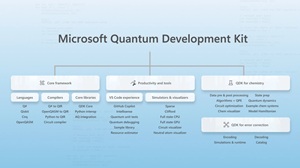 [Click on image for larger view.] QDK (source: Microsoft).
"Microsoft's QDK is fully integrated with VS Code and GitHub Copilot," said Matthias Troyer, Technical Fellow and Corporate Vice President of Quantum at Microsoft, in a Jan. 22 blog post. "After installing the QDK extension from the VS Code Marketplace, GitHub Copilot simplifies the use of QDK features in VS Code, including Python and Jupyter integration, circuit rendering, IntelliSense, breakpoint debugging, local simulators, visualizations, histograms, hardware submission, and resource estimation. With GitHub Copilot and the QDK, programming tasks such as code generation, unit tests, and job submissions are faster and easier than ever before."
Further detailing the VS Code focus, the open-source qdk GitHub repo says: "The easiest way to develop in this repo is to use VS Code. When you open the project root, by default VS Code will recommend you install the extensions listed in .vscode/extensions.json. These extensions provide language services for editing, as well as linters and formatters to ensure the code meets the requirements (which are checked by the build.py script and CI)."
The repo also details the QDK "Playground," a simple website for interacting with Q# (similar to what was reported in 2024 in the Visual Studio Magazine article "Use Azure Quantum 'Playground' to Explore New v1.0 Dev Kit").
Two new extensions, QDK for Chemistry and QDK for Error Correction, target researchers working on quantum chemistry workloads and quantum error-correction workflows, respectively. Both are designed to support near-term quantum hardware and to help developers build realistic, domain-specific quantum applications.
Microsoft also detailed updates to its Quantum Platform, an end-to-end environment that combines quantum hardware, software, AI, and high-performance computing. The platform uses a qubit-virtualization system and integrates with quantum processing units from hardware partners to produce logical qubits by correcting errors in high-quality physical qubits. A quantum operating system manages and monitors these devices through Azure, and the platform is designed to work across multiple quantum hardware types. Microsoft is currently co-designing Magne, described as the world's most powerful quantum computer, with Atom Computing's neutral-atom technology.
The Current State of Quantum Apps
While quantum computing is still in its early stages, real quantum applications do exist today--primarily as hybrid workflows that combine classical compute with quantum circuits running on cloud-accessible quantum hardware. Chemistry and materials science remain the most active areas: companies in pharmaceuticals, energy, and automotive research are using quantum algorithms to model molecules, reaction pathways, and catalysts that are too complex for classical simulation. These early quantum chemistry apps aren't delivering commercial breakthroughs yet, but they're proving out workflows that could eventually accelerate drug discovery, battery development, and materials engineering.
Other sectors are experimenting with quantum-enhanced optimization and machine learning. Financial institutions are testing quantum approaches to portfolio optimization and risk modeling, while logistics and manufacturing teams are exploring quantum methods for routing, scheduling, and resource allocation. Quantum machine learning is also gaining traction, with researchers building hybrid quantum-classical models for anomaly detection, pattern recognition, and dimensionality reduction. None of these applications are "production" in the traditional sense, but they represent a growing ecosystem of real workloads that developers can run today on IBM, Quantinuum, IonQ, and other cloud-based quantum systems--the same kinds of workloads Microsoft is now trying to make more accessible through VS Code, Copilot, and its expanded QDK.
About the Author
David Ramel is an editor and writer at Converge 360.