In-Depth
Copilot Billing Shock Hits Developers
I was shocked when a thorny problem with an AI agent in Visual Studio Code used most of my monthly Copilot Pro credits on day 1 of the new usage-based billing model.
On Day 4, I see I'm not alone.
Social Media: 'you can easily spend 20k bucks a month there'
I'm looking at a social media post about the issue and a telling comment hit home for me: "I cancelled it on 2nd june itself lol. Just asked a few questions on a code base and it was like 14% of the quota and I was like, naa there is no way am getting shi done with this in this month lol
."
Another comment on the same post, published today: "Cancelled mine yesterday after I used 50% of my tokens on a small feature, switching to Codex or Claude
."
Another comment: "Pro+ user here. 50% of my credits gone in 2 days 😭 Not running Ralph loops, just implemented some features in my code base."
The comments were in response to a post asking: "To people paying for GitHub Copilot after the price changes: Why?
"
The answers varied, but that initial credit shock, which I experienced myself, was echoed by several users. A couple more:
- "I'm ok with paying a bit more (#github was generous), but going from $80/m to (projected) $1,000/m is ridiculous."
-
"The reality is that copilot was changed from an empowering tool to a money siphon.
you can easily spend 20k bucks a month there"
In my case, which I readily admit is surely exacerbated by poor prompting practices (with Copilot advising better practices when I asked), I saw 1,227 of my allotted 1,500 free monthly credits basically eaten up on day 1, or about 82% of my allotted credits. If that pace continued, I was headed for a $180 bill for the month (see "Slammed by Copilot Usage-Based Billing on Day 1, Facing $180 Bill for June").
After a couple days of "normal" usage, I've used 98% of my monthly credits. After that my "Additional usage" budget will kick in. But that's better than the $1,000 projection and nightmare $20,000 scenario mentioned above on yesterday's post, which is nearing 59K views. I mostly use Copilot in VS Code to format freelance articles or guide me through hands-on agentic AI workflow on projects undertaken to write articles like yesterday's "Hands On with GitHub Copilot App Technical Preview: Turning a Blazor Issue into a PR." My initial spike was caused by a formatting agent gone awry somehow and my efforts to enlist Copilot to get it back to normal behavior. I can't imagine the credit crunch that hardcore developers are facing.
The image below was provided by a user who said:
Turned off ALL MCP servers. Guess what?
Copilot still eats ~29k tokens (≈ 29 AI credits) every time I send a message, even "lol".
7,000 monthly credits = ~240 messages (8 per day) before it has even done ANY work.
This can't be the intended experience!
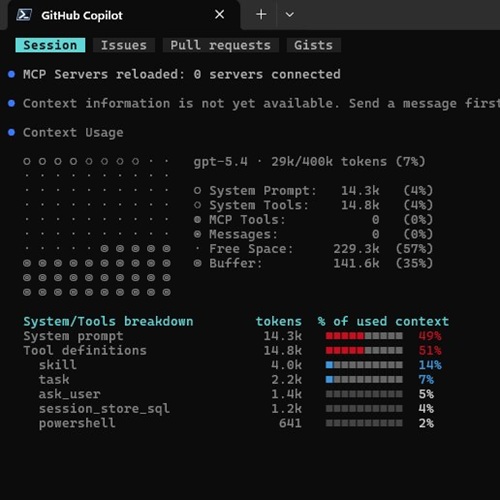 Copilot Usage (source: X).
Here's my own usage graph after that nightmarish first day and a couple "normal" days of usage:
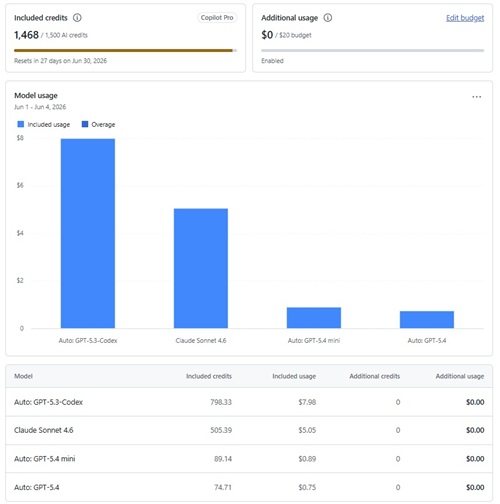 [Click on image for larger view.] My Copilot Usage (source: Ramel).
GitHub announced the June 1 billing change in April, saying "Instead of counting premium requests, every Copilot plan will include a monthly allotment of GitHub AI Credits, with the option for paid plans to purchase additional usage. Usage will be calculated based on token consumption, including input, output, and cached tokens, using the listed API rates for each model."
Immediately the backlash began (see "Devs Sound Off on Usage-Based Copilot Pricing Change: 'You Will Get Less, but Pay the Same Price'").
That user comment in the headline didn't exactly ring true for me. I'm going to get less and pay more, looks like.
GitHub provides more guidance at Usage-based billing for organizations and enterprises.
The backlash has intensified once users like me saw the immediate impact.
Reddit Thread: 'burning money'
"GitHub just switched Copilot to metered billing, and developers are watching months of credits vanish in a single day" is the title of a Reddit thread today.
Some comments from that thread:
- Just had a look internally and quick calculations paints a picture that we will be burning money in one month eqvivalent of what 1 full time employee in developed country would cost in a year. We have about 80 developers using AI. So I could hire 12 more people for the cost of AI.
- Ive tested new system with copilot… and it burned $30 for 1 simple ticket to implement (like 4 classes, not complicated logic)
- Metered billing is the reckoning… when people realize how much it costs to actually run large models, the viable use cases… shrink significantly.
- More likely to cause a crash… it's going to spread the chaos to all the companies now using their technology.
Hacker News Thread: 'burned through ...'
Comments on a Hacker News thread started by The Register ("Angry devs vow to flee GitHub Copilot as metered billing takes hold") were similar:
- Burned through 50+% of my monthly quota today using Sonnet 4.6, after starting the day at 0%. Only used it on an average daily workload, same as what I'd done all last month, and I used maybe 52% throughout all of May.
- Burned trough 30% of our included credits yesterday, while intentionally attempting to use less.
- It's like 80-100X more expensive if my calculations are correct.
GitHub Community Discussion Thread: 'just had a terrible experience...'
Some comments on a GitHub Community issue (the April 17 announcement) were similar:
- Just had a terrible experience with the new Copilot Pro+ billing model. I only asked one simple question using GPT-5.5, the session lasted just 3 minutes and I even manually paused & terminated the response midway. Shockingly, it ate up 405.1 credits (5% of my total monthly quota), roughly $2 for a single query. This pricing is totally unreasonable and way too expensive for daily use. Hope the team can look into this abnormal credit consumption issue.
- ... After that single request, my usage jumped to 622.97 AI Credits ($6.23). Not after a day of usage. Not after dozens of prompts. After ONE request.
- Happened to me as well, 54% of my monthly quote gone with just one request 822 credits gone in a single request, and the project that I am working on is just a small project with few screens
- are github copilot guys crazy? my 12% of total ai credits burned like anything for very minor task. I used Claude Sonnet 4.6 as usual and in response it barely updated 2-3 lines in total 6 files which costed like ~$0.35 per line updates.
- one afternoon pro+ limit 85%
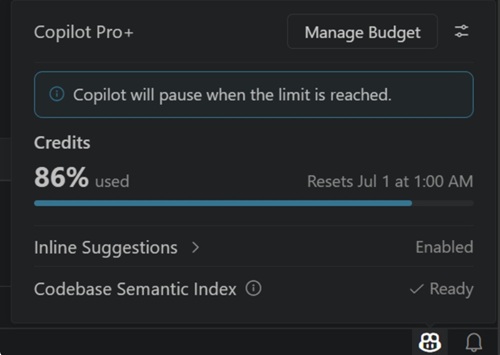 [Click on image for larger view.] One Afternoon (source: GitHub).
- I upgraded to MAX and started to restructure some docs in my project and after that I did a few task for some implementations - I ended up spending all my MAX credits under 24 hours, this is crazy....
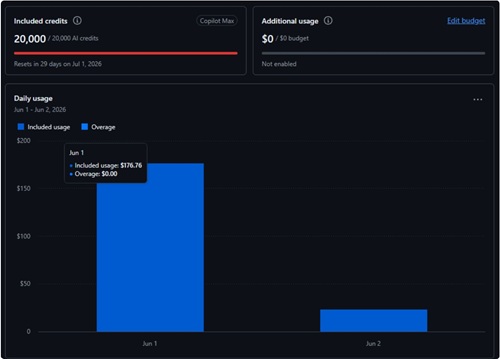 [Click on image for larger view.] 'This is crazy' (source: GitHub).
Last month on Pro+ and a budget on $100 - no problem...
You get the idea. All these threads featured the word "canceled" a lot and included some heated criticism.
So What To Do About It?
It's obviously a big issue and I could list the vitriol all day long, but what can developers do about it? As I mentioned, Copilot gave me some advice on better prompting practices, including don't paste in huge chunks of text into a prompt, compact long chats earlier, split work into smaller sessions and more. Again, consult that article for the full gamut of advice and mitigating strategies going forward.
For its part GitHub, along with the billing change announcement, said: "As part of this release, we're also launching new user-level budget controls, expanded context windows, and enabling upgrades to Copilot Max." It also pointed to a FAQ on the issue. It also published Getting started with budget controls, explaining how to "Set up budget guardrails for your enterprise before your team starts consuming AI credits." Accompanying documentation is titled "Optimizing your budget configuration" to help "Find the right combination of budget controls for your organization based on your size, structure, and spending goals."
But that's about it. Neither GitHub nor Microsoft has responded to the backlash directly, at least as far as I could find. They've just published guidance, such as Microsoft's Manage Copilot usage and models
So I asked Microsoft Copilot what tactics or strategies developers can use to mitigate the issue (I used Microsoft's free web version so as not to get bankrupted). It responded:
- Set hard budget caps immediately: Use Copilot's budget controls to enforce strict monthly and per-user spending limits so runaway sessions can't spiral into large bills.
- Switch to cheaper models by default: Configure your IDE or Copilot settings to prefer lower-cost models for routine tasks, reserving premium models only for complex reasoning or generation.
- Break large tasks into smaller prompts: Instead of asking for full-file rewrites or multi-step workflows, split requests into narrowly scoped steps to minimize token consumption.
- Avoid pasting large codebases blindly: Provide only the minimal relevant snippets or files; excessive context dramatically increases token usage on every prompt.
- Reset or compact long chat sessions: Long conversations accumulate context that gets reprocessed each time; start new chats or summarize context periodically.
- Use inline suggestions over chat when possible: Autocomplete and inline edits typically consume fewer tokens than conversational or agent-based workflows.
- Disable or limit agent/autonomous modes: Agent-style workflows (looping, planning, multi-step execution) can burn credits quickly; use them sparingly and monitor usage closely.
- Turn off unnecessary integrations (e.g., MCP servers): External tools and context providers can silently inflate token counts even for simple prompts.
- Pre-edit and constrain prompts: Clearly specify desired output length, format, and scope (e.g., "limit to 20 lines" or "only modify this function") to reduce verbose responses.
- Review responses early and stop generation: Cancel outputs once you have sufficient information instead of letting long responses complete unnecessarily.
- Cache or reuse known-good outputs: Store useful generated snippets locally instead of re-querying Copilot for the same logic repeatedly.
- Monitor usage daily: Check dashboards frequently to spot abnormal spikes early and adjust behavior before hitting caps.
- Adopt team guardrails: In organizations, enforce per-project or per-team budgets and restrict model access based on role or need.
- Use AI for high-value tasks only: Avoid trivial queries (formatting, simple syntax reminders) that can be handled faster and cheaper manually.
- Benchmark alternative tools: Compare cost efficiency across different AI coding assistants and shift workloads where economics are more favorable.
- Batch related questions: Combine tightly related micro-questions into a single concise prompt instead of sending many small messages.
- Prefer deterministic tools when possible: Use linters, formatters and static analysis tools instead of AI for routine transformations.
- Educate teams on prompt efficiency: Train developers on token economics, prompt design, and cost-aware usage patterns to prevent accidental overuse.
Good luck.
I would love to get more comments on this. Email me your experience at [email protected].
About the Author
David Ramel is an editor and writer at Converge 360.