News
Copilot AI Billing Shock Met with Meters, Caps and Token-Saving Tools
Today, devs using GitHub Copilot were told they can now see AI credits used per billing cycle. A few days ago, multiple enhancements to usage metrics functionality were announced.
Tomorrow or soon after there will be more such actions.
All these moves show how aggressively Microsoft and GitHub are trying to take the edge off GitHub Copilot's new usage meter: a per-session spending cap for unattended agents, real-time Visual Studio warnings before overages begin and cycle-to-date AI Credit totals for Business and Enterprise users who previously had no meaningful personal gauge.
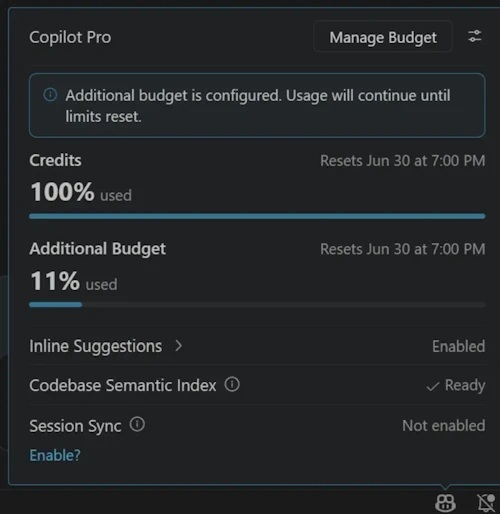 Manage Budget (source: Microsoft).
They are just the latest examples of Microsoft and GitHub trying to help developers thrive -- or at least not cancel their subscriptions -- under the new usage-based billing model for Copilot. That June 1 change caused sticker shock around the world when devs started seeing their monthly credits chewed up in a day or two.
GitHub originally announced in April that Copilot would replace premium requests with AI Credits, a usage unit derived from model input, output and cached tokens. The company said the change was necessary because agentic workflows involve more inference, longer-running tasks and multi-step work, making the previous premium-request model "no longer sustainable."
Sorting out some of the more recent moves, GitHub introduced the session-level AI Credit limit for Copilot CLI and the Copilot SDK on July 1. That was followed by a refreshed Copilot Usage window in Visual Studio with approaching-limit, limit-reached and paid-overage alerts. On July 20, GitHub added cycle-to-date consumption totals for Copilot Business and Enterprise users, even when administrators have not assigned them individual budgets.
Those additions join a fast-growing collection of credits, discounts, dashboards, spend meters, budget controls, token-efficiency improvements and official usage advice released before and after Copilot switched to token-based billing on June 1.
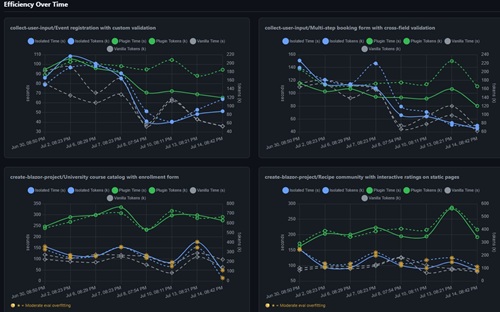 [Click on image for larger view.] Efficiency Over Time (source: GitHub).
The response is substantial and seems to falls into two distinct categories. A small number of measures directly improve the financial equation by expanding included usage or discounting some model calls. Most help developers and administrators monitor, limit or reduce consumption rather than reverse the pricing change itself.
Code completions and Next Edit Suggestions remain unmetered on paid plans, but Copilot Chat, coding agents, Copilot CLI, code review, Spaces, Spark and other advanced features consume credits based on the underlying model and the number and type of tokens processed.
Developers quickly reported unexpectedly rapid credit depletion and projected bills far above their previous fixed subscription prices. Visual Studio Magazine
documented the reaction as the change took effect, including one from me, who immediately facing a projected $180 June bill on the first day and a broader collection of reports describing Copilot billing shock among developers.
The complaints have continued as users gain more experience with the system. In a long-running GitHub Community discussion, one user reacted to a small included allowance in July by saying, "That's not gonna last a day." Another reported abandoning Copilot for a lower-cost combination of Kilo Code and DeepSeek: "I just ended up switching to Kilo + Deepseek. It's so cheap."
A separate June 11 community report illustrates another source of frustration: a Copilot Pro user said the service showed all 1,500 credits exhausted even though the itemized dashboard entries visible to the user added up to only 969.31 credits. That self-reported discrepancy has not been independently verified, but it reflects the continuing difficulty some developers have had reconciling overall consumption with the available detail.
The Measures That Actually Change the Math
The clearest financial concession came when GitHub increased the included value of individual subscriptions after acknowledging questions about whether the initially announced allowances would support longer agent runs and multi-step work.
| Plan |
Monthly Price |
Base Credits |
Flex Credits |
Total Included Value |
| Copilot Pro |
$10 |
$10 |
$5 |
$15 |
| Copilot Pro+ |
$39 |
$39 |
$31 |
$70 |
| Copilot Max |
$100 |
$100 |
$100 |
$200 |
The flex allotments are included automatically without raising subscription prices. However, GitHub describes flex as a variable benefit that may change as model prices and AI economics evolve. Only each plan's base allowance is fixed.
Business and Enterprise customers are also receiving a temporary cushion during the first three months of the new billing system. Existing Copilot Business seats receive 3,000 credits per user instead of the permanent 1,900, while Copilot Enterprise seats receive 7,000 instead of 3,900. The promotional allowance runs through August and ends Sept. 1.
GitHub advises organizations to use that period to establish a consumption baseline and resize budgets before the smaller permanent pools take effect. Otherwise, companies accustomed to the promotional allowance could encounter a second apparent cost shock in September.
Included enterprise credits are pooled rather than isolated by employee. An organization with 100 Copilot Business seats, for example, receives a shared monthly pool of 190,000 credits. Light users can therefore offset heavier users instead of leaving individual allowances stranded.
GitHub also provides a direct price incentive for using automatic model selection. Paid subscribers receive a 10 percent discount on model costs when Auto is used in Copilot Chat, Copilot CLI, the Copilot app or the Copilot cloud agent. Auto considers task complexity, service health and availability, routing simpler work to less costly models while reserving more expensive reasoning models for harder tasks.
Existing annual Pro and Pro+ customers may remain on the legacy premium-request system until their annual terms expire. GitHub also documents prorated refunds and monthly-plan conversions for users who do not want to wait for renewal, while plan upgrades are prorated rather than double-billed.
A Growing Stack of Guardrails
Where the financial concessions are relatively limited, GitHub's spending-control system is becoming increasingly elaborate.
The new Copilot CLI and SDK session limits are designed for agent runs that could otherwise continue unattended. Developers can use the /limits command interactively or pass --max-ai-credits to a scripted session. The calculation includes primary model calls, subagents and background work such as conversation compaction.
The cap is soft rather than absolute because a response already in progress is allowed to finish, meaning the final total can slightly exceed the selected limit. It also applies only to a single session and does not replace monthly account or enterprise budgets.
For organizations, GitHub recommends starting with a universal user-level budget, calling it the "single most important control" in its enterprise budget guidance. The budget caps each licensed developer's combined consumption from the included pool and any paid overage.
Administrators can then create exceptions for power users, assigning higher or lower individual limits without changing the default for everybody else. GitHub also added cost-center user-level budgets that automatically follow employees as they join, leave or move between teams.
Another control addresses a different enterprise concern: preventing one department from consuming the credits purchased for another. Included-usage caps for cost centers calculate each group's share from its assigned Business and Enterprise seats. When that group reaches its allowance, administrators can block further use or allow consumption to continue as paid overage.
Enterprise, organization and cost-center spending limits apply after the shared pool has been exhausted. Administrators need to pay attention to how those limits are configured, however. GitHub warns that broader spending limits can function only as notification thresholds unless "Stop usage when budget limit is reached" is enabled. User-level budgets are always hard stops.
A July 10 REST API update makes the controls more manageable at scale by returning every covered user's progress against universal and cost-center budgets. Administrators can filter for users above a selected consumption percentage, sort by usage and identify individual overrides before limits are reached.
Meters Everywhere
Microsoft and GitHub have also been filling in visibility gaps from the individual response to the enterprise billing account.
VS Code 1.125 introduced a Copilot spend meter showing how much of a developer's configured additional-usage budget had been consumed. VS Code 1.126 then added session-level cumulative cost, allowing developers to spot individual conversations that had become unusually expensive.
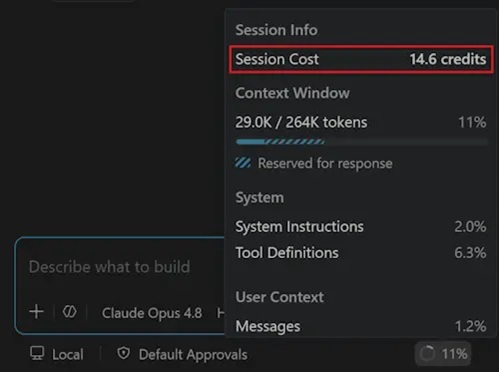 Session Cost (source: Microsoft).
VS Code 1.127 went deeper by showing the credits attributable to individual subagents. Developers can hover over delegated-work sections to see how much of a visible request was consumed by less-visible agent activity.
Visual Studio followed with its refreshed Copilot Usage window, covered in Visual Studio Takes Aim at Copilot Billing Shock. The window provides real-time usage information, configurable warning thresholds and separate alerts for approaching the allowance, reaching it and entering paid overage.
GitHub's broader AI Usage interface can break consumption down by user, organization, cost center and model, while supporting filtering and exports. The native interface is replacing the temporary Copilot Billing Preview app, which GitHub plans to retire Aug. 3 because the standard billing system now contains information the preview reports could not represent.
GitHub has also been correcting gaps and attribution problems in its reporting. The Copilot usage metrics API now includes per-user daily AI Credit consumption, although GitHub cautions that the metric is intended for analytics and may not match an invoice total.
Organizations wanting to build their own dashboards can use enterprise-managed OpenTelemetry export for VS Code and Copilot CLI. The telemetry can cover model calls, input and output tokens, cache reads, cache creation, tool execution, subagent activity, session duration and round trips.
The expansion is moving quickly enough that a public token-efficiency dashboard is now part of Microsoft's evaluation of built-in Visual Studio Agent Skills.
Microsoft Is Also Trying to Burn Fewer Tokens
Not all of the response is about displaying or stopping consumption. Microsoft has made engineering changes intended to reduce the amount of billable context Copilot needs to process.
The clearest collection appeared in VS Code 1.118, whose release notes explicitly connected token-efficiency work to the coming billing transition.
Microsoft reported that after an agent conversation is established, more than 93 percent of each request can be reused from the prompt cache. Cached context is still billable, but it is generally priced below newly processed input. Microsoft cited Anthropic pricing under which repeated cached context could cost approximately one-tenth as much as fresh input.
VS Code also stopped inserting every available tool definition into every request. Instead, it keeps a core group of roughly 30 commonly used tools immediately available and loads less-frequent tools only when needed. Microsoft said the core set covered about 88 percent of tool calls and that deferred tool loading produced token savings of up to 20 percent in testing.
Separate, smaller models now handle some search and command-execution work rather than placing every operation in the expensive primary model's context. Microsoft again reported savings of up to 20 percent in testing, while the specialized execution tool limits repeated terminal calls and filters noisy output before returning it to the main agent.
The billing change is also affecting defaults in Visual Studio. Microsoft's built-in .NET and Azure Agent Skills remain disabled while the company evaluates their quality, speed and token efficiency. The Visual Studio team said it wants to ensure that "every token you spend is meaningful" before enabling them automatically.
The New Copilot Operating Manual
Microsoft and GitHub are increasingly putting some responsibility for cost control on developers themselves. Their combined guidance now amounts to a new set of working practices for agentic development.
| Recommended Practice |
Cost Rationale |
| Use lightweight models for routine work |
Reserve expensive reasoning models for architecture, difficult debugging and complex refactoring. |
| Use Auto model selection |
Routes simpler work to cheaper models and applies the 10 percent Auto discount. |
| Plan first, then implement |
Use a reasoning model for research and planning, then start a focused implementation session with a less costly model. |
| Start a new chat when the task changes |
Prevents an unrelated task from repeatedly resending accumulated conversation history. |
| Fork related conversations |
Reuses relevant context for an alternate approach without manually reconstructing it. |
| Keep repository instructions concise |
Long generic instruction files are injected repeatedly and consume tokens on every run. |
| Provide a project map |
Directs the agent to important code, tests and commands without exploratory searches across the repository. |
| Disable unnecessary tools and MCP servers |
Every enabled tool contributes definitions and potentially large output to the context. |
| Exclude generated files and noisy directories |
Prevents logs, build output and generated code from appearing in searches and indexing. |
Use /compact in long sessions |
Summarizes older conversation material and frees context space. |
| Use default reasoning effort for ordinary tasks |
Higher thinking levels can generate substantially more reasoning tokens. |
| Add tests, linters and security scans |
Deterministic failures stop agents before they build long chains of work on an incorrect result. |
GitHub's AI usage optimization guide also recommends the /chronicle tips and /chronicle cost-tips commands, which analyze recent Copilot CLI and VS Code sessions for costly patterns, heavily used tools and workflow changes that could lower consumption.
VS Code's corresponding usage-optimization guidance emphasizes monitoring the cost of individual turns and sessions, keeping prompt caches stable and avoiding unnecessary mid-session changes to models, reasoning effort, instructions, tools and MCP servers.
Some Alternatives Shift the Cost Elsewhere
Microsoft is also expanding options that allow developers to move some work away from GitHub's AI Credit system.
Visual Studio supports Bring Your Own Model connections to OpenAI, Anthropic and Google accounts, while VS Code has been expanding support for provider extensions, custom endpoints and local models. Those choices can reduce Copilot consumption, but they do not make inference free. Charges move to the external provider, or developers incur the hardware, energy and administration costs of running models locally.
That makes model switching more accurately a cost-allocation strategy than a universal cost-reduction strategy.
IBM Suggests the Concern Is Industrywide
Microsoft and GitHub are not alone in treating AI coding costs as a product and governance problem.
A recent TechTimes report on IBM Bob framed token bills as an emerging boardroom issue as development tools coordinate more models and agents behind each visible task.
IBM's own July 9 Bob announcement introduced multi-agent coordination, model-to-task matching and built-in analytics for AI use and cost. IBM's Bobalytics tooling provides visibility into adoption, use and cost optimization, while enterprise pricing controls let organizations distribute and track Bobcoin entitlements.
The parallel is notable. As coding assistants evolve from autocomplete into agent systems capable of launching subagents, invoking tools and continuing through multiple steps, vendors are adding cost orchestration alongside task orchestration.