News
Microsoft Ships Stable Versions of OpenAI Libraries for .NET and Azure
Further leveraging the relationship that vaulted Microsoft and OpenAI into leadership positions in the AI era, Microsoft this week announced stable versions of two new OpenAI libraries.
Those would be the official OpenAI library for .NET (the OpenAI NuGet package) and the companion stable release version of the Azure OpenAI library for .NET project parked on GitHub (called Azure.AI.OpenAI on NuGet).
 [Click on image for larger view.] OpenAI .NET API Library (source: Microsoft).
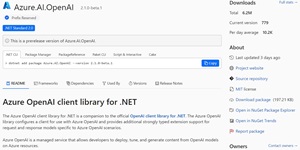 [Click on image for larger view.] Azure OpenAI Client Library for .NET (source: Microsoft).
"Back in June, we launched the first beta of the OpenAI library for .NET, empowering developers to integrate advanced AI models into their applications," Microsoft's .NET Team said in an Oct. 1 post. "Today, we are excited to share that the stable release of the official OpenAI library for .NET is now live. This release ensures a smooth and reliable integration experience for developers working with OpenAI and Azure OpenAI services in their .NET applications."
Its purpose is to provide tools to simplify integrating OpenAI's cutting-edge models into .NET applications, offering developers a streamlined experience with features including, in Microsoft's words:
- Full OpenAI REST API support: Includes Assistants v2 and Chat Completions, enabling flexible and advanced interactions.
- Support for latest models: OpenAI's latest flagship models, including GPT-4o, GPT-4o mini, o1-preview, and o1-mini, are fully supported, ensuring developers have access to cutting-edge AI capabilities.
- Extensibility: The library is designed with extensibility in mind, allowing the community to build additional libraries on top of it.
- Sync and async APIs: These ensure developers have the flexibility to use synchronous or asynchronous patterns depending on their application's needs.
- Streaming completions: Access to streaming completions via IAsyncEnumerable, offering more dynamic interaction models.
- Quality-of-life improvements: Numerous improvements have been made throughout the beta cycle based on community feedback.
- .NET Standard 2.0 compatibility: This library, written in C#, supports all .NET variants that implement .NET Standard 2.0, ensuring compatibility with the latest .NET platforms.
Its GitHub repo explains how to work with Azure OpenAI:
For Azure OpenAI scenarios use the Azure SDK and more specifically the Azure OpenAI client library for .NET.
The Azure OpenAI client library for .NET is a companion to this library and all common capabilities between OpenAI and Azure OpenAI share the same scenario clients, methods, and request/response types. It is designed to make Azure specific scenarios straightforward, with extensions for Azure-specific concepts like Responsible AI content filter results and On Your Data integration.
The Azure offering was the subject of its own blog post, which you can read here.
About the Author
David Ramel is an editor and writer at Converge 360.