News
Microsoft Busts the 'Myth of AI/ML and Java'
Microsoft, contradicting beliefs of Java developers responding to a survey, said they don't need to learn AI, master machine learning, or switch to Python to build intelligent, production-ready applications.
After finding that a survey of 647 Java developers indicated that some 90 percent of respondents believed that building intelligent Java applications requires deep knowledge of AI, machine learning, or Python, the company busted what it called the "myth of AI/ML and Java."
Developers can start to deliver production-grade intelligent Java apps without AI, ML or Python skills, the company said in a May 12 post titled, "The State of Coding the Future with Java and AI -- May 2025," authored by Asir V Selvasingh, principal architect - Java on Microsoft Azure.
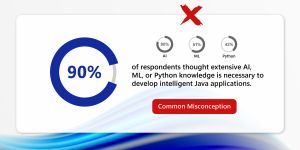 [Click on image for larger view.] Common Misconception (source: Microsoft).
Selvasingh backed up that claim with these bullet points:
- Java developers already have what they need -- today -- to build intelligent applications using modern Java-first frameworks such as Model Context Protocol (MCP) Java SDK, Spring AI, or LangChain4j.
- No prior experience in Python or Machine Learning is required for Java developers to begin adding intelligent features to their apps.
- Connecting a Java application to backend AI systems -- including Large Language Models and Vector Databases -- is conceptually like working with REST APIs or traditional SQL and NoSQL databases.
-
Modern libraries like MCP Java SDK, Spring AI, and LangChain4j make it easier for developers to build and enhance AI-powered Java applications. These frameworks offer support for:
- Retrieval-Augmented Generation (RAG)
- Conversational memory
- Conversation logging
- Integration with vector stores
- Secure, observable, and safe-by-default interactions
- Streamed outputs and structured reasoning
- Java continues to play a leading role in enterprise software. This gives Java developers a natural advantage -- and a unique opportunity -- to lead the way in delivering intelligent features inside core business applications.
- It is also important to note that tasks requiring deep AI and Data Science knowledge are best left to specialists. Java developers can focus on app logic, integration, and delivering business value without needing to become AI experts themselves.
The report, framed as part of Microsoft's ongoing efforts to empower developers across ecosystems, outlines how Java professionals can seamlessly integrate modern AI capabilities into their existing workflows. For that, the company's survey invite said: "Calling all Java pros -- share your insights to help simplify AI-powered apps." The post also highlights broader insights from the survey and details the growing suite of tools and frameworks designed to bring generative AI development into the Java mainstream.
Beyond myth-busting, the report explores how Java developers can practically implement AI features using tools and patterns that feel native to their ecosystem.
Microsoft positions these tools as part of a broader, cross-language strategy to standardize AI development experiences. The report underscores that AI integration is becoming as intuitive as working with REST APIs or databases. With this shift, Java developers are well-placed to lead enterprise AI adoption without needing to pivot to Python or data science roles.
In answering survey questions, Microsoft asked Java pros to imagine this scenario:
Picture yourself adding an AI-driven feature to an existing Java-based app or building a brand-new intelligent application. This feature might improve customer experience -- such as personalized recommendations -- optimize business processes -- like fraud detection -- or enhance product searches using natural language. Your goal is to seamlessly integrate this feature, ensuring it is easy to develop, scalable, and maintainable.
Specific takeaways from the post include:
- 97% of developers said they would choose Java for building intelligent applications if approachable tools and frameworks were available.
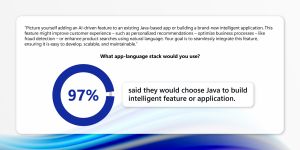 [Click on image for larger view.] Choosing Java (source: Microsoft).
- Related to the above, Spring AI led the list of frameworks or libraries devs would consider for building or integrating AI into Java apps.
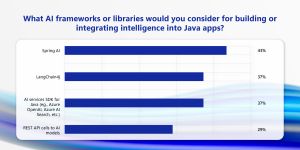 [Click on image for larger view.] AI Frameworks/Libraries (source: Microsoft).
- The RAG pattern and agentic systems were identified as essential for AI-powered Java apps.
 [Click on image for larger view.] Essentials (source: Microsoft).
When asked about top challenges encountered, respondents listed:
- Lack of clear starting points and step-by-step guidance.
- Feeling overwhelmed by the variety of AI models, libraries, and tools.
- Misconceptions that machine learning expertise is required.
- Complexity with integrating AI features into existing applications -- particularly introduced by suboptimal patterns such as directly calling REST APIs through low-level HTTP libraries, invoking Python-based routines through external OS processes, or loading models into the application's memory at runtime using local weights and GPU resources.
- Missing features in some of the current libraries and frameworks.
- Uncertainty about scaling applications and safely using private models on the cloud.
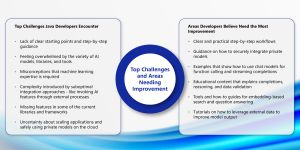 [Click on image for larger view.] Challenges and Areas Needing Improvement (source: Microsoft).
Asked what areas they believed the most improvement, respondents listed:
- Clear and practical step-by-step workflows.
- Guidance on how to securely integrate private models.
- Examples that show how to use chat models for function calling and streaming completions.
- Educational content that explains completions, reasoning, and data validation.
- Tools and how-to guides for embedding-based search and question answering.
- Tutorials on how to leverage external data to improve model output.
"The message from 647 Java professionals is clear: Java developers are ready -- and the tools they need to build intelligent applications are already here," said Selvasingh.
"If you are a Java developer and have not started your AI journey yet now is the right time. You do not need to become an AI expert. You do not need to change your language, tools, or working style. Modern Java frameworks and libraries like Spring AI, LangChain4j, and the MCP Java SDK are designed to work the way you already build -- while making it easier to add intelligence, automation, and smart experiences to your applications."
About the Author
David Ramel is an editor and writer at Converge 360.