News
Microsoft Again Named a Leader in AI AppDev Platforms Research
Microsoft was again named a Leader in Gartner's 2025 Magic Quadrant for AI Application Development Platforms, placing the company alongside Amazon Web Services (AWS), Google and IBM in an evaluation focused on enterprise platforms for building AI-enabled applications.
In its report, Gartner evaluated platforms designed to help software engineering teams design, build, test, deploy and govern AI-embedded applications, including AI assistants, AI agents and multimodal applications. The research reflects growing enterprise demand for production-ready AI platforms that emphasize governance, grounding and operational scale.
Microsoft's Position Among the Leaders
Microsoft's Azure AI Foundry, now branded as Microsoft Foundry, was positioned in the Leaders quadrant and placed furthest for Completeness of Vision.
Gartner said: "Microsoft's Azure AI Foundry customers are global. Azure AI Foundry is introducing additional data residency options in Indonesia, Malaysia and Spain, as well as additional options in U.S. Azure government environments. Microsoft's fastest-growing verticals are healthcare, manufacturing, and retail and consumer goods. In 2025, Microsoft upgraded Azure AI Foundry Agent Service by adding MCP support, and it launched the Agent Factory framework for enterprise agent development."
In a Dec. 17 company blog post announcing the recognition, Microsoft said, "This leadership reflects a long-term conviction: the next wave of applications is agentic, and real customer impact requires far more than great demos."
Microsoft emphasized that enterprise AI adoption requires more than model access, pointing instead to the need for agents that are "grounded in real data and tools, capable of driving business workflows, and governed with end-to-end observability at scale." The company cited ongoing investment in agent frameworks, orchestration and governance as central to its platform strategy.
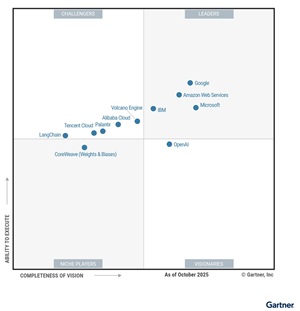 [Click on image for larger view.] 2025 Magic Quadrant for AI Application Development Platforms (source: Gartner).
As in most MQ reports, things haven't changed much since last year.
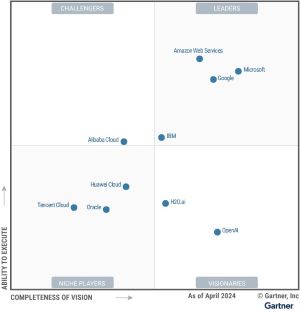 [Click on image for larger view.] 2024 Magic Quadrant for Cloud AI Developer Services (source: Gartner).
According to Microsoft, Gartner's evaluation criteria align with the company's focus on delivering production-ready AI rather than proof-of-concept tooling. "Being positioned furthest on vision isn't about having the boldest roadmap: it's about whether that vision translates into the real capabilities customers need for the future of AI," the blog post said.
Foundry Focus Areas Highlighted by Microsoft
Microsoft said its Foundry platform has been shaped around four areas it believes distinguish production AI from experimentation. These include secure grounding of agents in enterprise data, workflow integration beyond conversational interfaces, organization-wide observability and governance, and deployment flexibility from cloud to edge.
The company noted that Foundry integrates directly with developer and enterprise tooling, including Visual Studio Code, GitHub, Azure and Microsoft 365, positioning it as part of a broader development and productivity ecosystem familiar to .NET and cloud developers.
Microsoft also disclosed that it used its own agent technology as part of the Magic Quadrant submission process. The company said it developed custom agents using its Microsoft Agent Framework to collect, organize and validate submission data, reducing manual effort and improving accuracy.
Market Overview and Key Trends
Gartner characterized the AI application development platform market as one of the fastest-growing segments in enterprise software, estimating the market exceeded $5.2 billion in 2025 with annual growth above 30 percent. The firm tied that growth to rising demand from software engineering and IT teams tasked with embedding AI capabilities directly into production applications.
Key highlights include:
- The introduction of Model Context Protocol and Agent2Agent Protocol standards
- Increased focus on managing the AI agent life cycle
- New regulations such as the EU AI Act and California's SB 53
- The rise of agent experience (AX)
- Enhanced fine-tuning and grounding techniques beyond retrieval-augmented generation
- The rise of open-weights and open-source offerings
- The heightened need for application security
Enterprises are moving away from fragmented, single-purpose AI tools toward consolidated platforms that support the full life cycle of AI-embedded applications, from design and development through deployment, governance and ongoing operations. These platforms are increasingly expected to reduce tooling complexity while enabling consistent governance, security and compliance across teams.
The report highlighted several market shifts that accelerated over the past year, including increased emphasis on AI agents capable of planning, orchestration and autonomous execution. Gartner noted that vendors are expanding beyond basic retrieval-augmented generation to support deeper grounding techniques, improved agent memory and richer observability into agent behavior.
Gartner also pointed to regulatory pressure and data residency requirements as key drivers influencing platform design, along with a shift toward fine-tuning as the most commonly used grounding approach. According to the firm's 2025 AI in Software Engineering Survey, 80 percent of respondents reported using fine-tuning, compared to 45 percent using retrieval-augmented generation.
Looking ahead, Gartner expects continued investment in features that reduce operational complexity, enhance security and support deployment across cloud, edge and device environments as agent-based architectures become more prevalent.
About the Author
David Ramel is an editor and writer at Converge 360.