News
VS Code 1.125 Adds Copilot Spend Meter After Billing Shock
Microsoft's latest Visual Studio Code release adds another cost-control signal for GitHub Copilot users, bringing additional-spend usage directly into the editor's Copilot status dashboard after developers reported unexpected usage spikes under GitHub's AI-credit billing model.
The Visual Studio Code 1.125 release notes, dated June 17, say the Copilot status dashboard now shows the percentage of a user's additional Copilot budget that has been consumed. Microsoft framed the feature as a way for developers to see budget consumption before reaching a configured limit, with detailed usage and additional-spend management still handled in GitHub Copilot settings.
"To make sure you stay ahead of overage charges, the Copilot status dashboard now shows the percentage of your additional Copilot budget that you've consumed, so you can adjust your usage before you hit your configured limit," the team said.
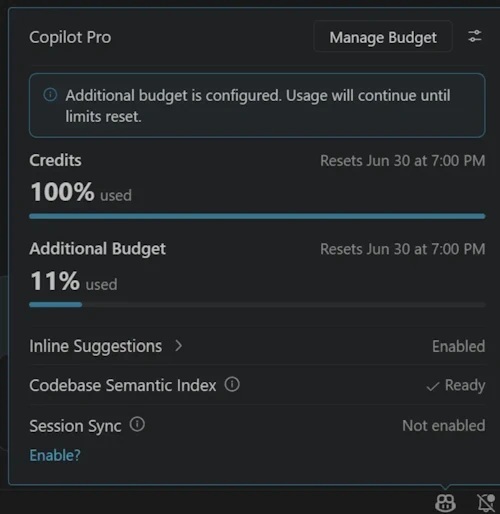 Manage Budget (source: Microsoft).
The change is small in surface area but significant in context. GitHub's June 1 billing update made usage-based billing active for all Copilot plans, with plans billing based on GitHub AI Credits consumed. The same GitHub update said that after included AI Credits are consumed, users can continue spending additional AI Credits and be billed at the end of the month by setting an additional spending budget. That made additional-spend visibility a practical concern inside the tools where developers are using agents, chat and model-based coding assistance.
From Efficiency to Visibility
VS Code 1.125 follows earlier cost-related changes that focused more on reducing consumption than showing spend status. In April, Visual Studio Magazine
reported that VS Code 1.118 arrived two days after GitHub's usage-based billing announcement with token-efficiency work in agent sessions. That earlier coverage cited VS Code release notes saying, "To help you get the most value out of your plan, we have been working on several initiatives to improve token efficiency without hindering the quality of the agent."
That April 30 Visual Studio Magazine article described several mechanisms that were intended to reduce token consumption before the billing switch. They included prompt caching in active agent sessions, a tool search approach that kept a smaller core toolset in context, and specialized tools for code search and terminal execution that could shift some work away from the main frontier model. The article said the release notes reported more than 93 percent cache reuse per request in active agent sessions and up to 20 percent token savings from some tool-related changes.
Those measures addressed a technical side of the billing problem: how much context and tool schema data agent sessions send to models. The VS Code 1.125 dashboard change addresses a different side: how much of a configured additional budget has already been used. Together, the releases show an incremental pattern in which Microsoft and GitHub have added both consumption-reduction features and user-facing budget information around Copilot usage.
Billing Shock After June 1
The need for more visible budget signals became clearer after the AI-credit model went live. In June 4 coverage, Visual Studio Magazine
reported that developers were complaining about routine prompts and agentic workflows quickly consuming monthly AI-credit allotments after GitHub's June 1 switch. That article described the author's own experience as 1,227 of 1,500 free monthly credits being consumed on the first day, or about 82 percent of the allotment.
The same article quoted GitHub's published description of the change: "Instead of counting premium requests, every Copilot plan will include a monthly allotment of GitHub AI Credits, with the option for paid plans to purchase additional usage. Usage will be calculated based on token consumption, including input, output, and cached tokens, using the listed API rates for each model." It also noted GitHub guidance around AI-credit pricing, plan limits, spending controls and budget configuration.
GitHub's own June 1 changelog said usage-based billing was live for all users and that all Copilot plans bill based on GitHub AI Credits consumed. It also said user-level budgets were generally available for organizations and enterprises, allowing admins to set a universal user budget or override budgets for specific users. For AI credits, GitHub said those user-level budgets control total usage, not just additional spend.
More Places to Monitor Consumption
The new VS Code dashboard percentage is one of several billing-visibility additions around Copilot. On May 12, GitHub said April usage reports were available so users and admins could see how April Copilot activity translated into AI credits before the June 1 launch. GitHub said those reports could help identify top consumers, show which models and surfaces drove the most consumption, and provide a working sense of monthly AI-credit ranges before the switch. It also cautioned that the report was a directional signal and "not a recalculated bill."
On June 19, GitHub added another monitoring signal, announcing that the Copilot usage metrics API now reports daily AI credits consumed per user. The new ai_credits_used field is available in single-day and 28-day user-level reports at the enterprise and organization levels. GitHub said the metric is an overall per-user total across Copilot activity and is not currently broken down by feature, model or surface.
Microsoft also published Visual Studio guidance for tracking Copilot usage and managing model choice. The Manage Copilot usage and models page says GitHub Copilot includes built-in tools to help track usage, manage a plan and understand how model selection affects monthly usage. It says Visual Studio can show monthly usage, remaining monthly balance, plan details and relevant billing actions, and that larger prompts and longer responses generally use more credits. It also says model choice affects cost, response quality and performance, and that higher-capability models usually consume more credits per prompt.
GitHub's billing documentation similarly states that Copilot usage is measured through a combination of licenses and AI credits, and that personal-account budgets can send email alerts at 75 percent, 90 percent and 100 percent of the budget. The same documentation says budgets help monitor spending but do not stop license charges, and says organization and enterprise owners and billing managers can set budgets at the user, organization, cost center and enterprise level to monitor and control AI-credit consumption.
Agent Workflows Raise the Stakes
The dashboard change is listed under the "Agents" section of the VS Code 1.125 release notes, matching the area where user concern has been especially acute. Agentic workflows can involve multiple tool calls, file reads, edits, terminal actions and repeated context passing. GitHub separately warned on June 4 that larger context windows and higher reasoning levels consume more AI credits per interaction, recommending default context and reasoning levels for everyday tasks and extended context or higher reasoning for complex, multi-file problems.
That means the billing experience is tied not only to subscription tier but also to workflow design, model selection, prompt size, response length, context window size, reasoning settings and agent behavior. VS Code 1.118 targeted some of those consumption drivers with efficiency work. GitHub's reports and API updates targeted measurement. VS Code 1.125 now adds an in-editor percentage display for additional-spend budget usage.
The practical result for developers is a more visible signal before overage charges hit a configured cap. For teams and billing administrators, it fits with a broader set of recent controls: prelaunch usage reports, organization and enterprise user-level budgets, per-user AI-credit metrics, IDE usage windows, model-cost indicators and token-efficiency work in agent sessions. None of those changes eliminates usage-based billing, but each adds either consumption reduction or earlier visibility into the costs created by Copilot activity.
About the Author
David Ramel is an editor and writer at Converge 360.