News
GitHub Copilot Swamps Gemini Code Assist, Amazon Q Among Engineers, AI Coding Survey Says
GitHub Copilot has nearly lapped the AI coding field in a new industry snapshot from Jellyfish. The Microsoft-backed assistant claimed the top spot among developers by a wide margin, outpacing rivals led by Gemini Code Assist, Amazon Q and others. With 90% of engineering teams now using AI tools and Copilot leading the charge, the report signals that AI-assisted coding is no longer a curiosity -- it's the new normal.
The findings come from the 2025 State of Engineering Management report by Jellyfish, a Boston-based company that provides Software Engineering Intelligence (SEI) platforms for tracking engineering performance, resource allocation, and AI adoption. Conducted in May 2025, the report surveyed 645 full-time professionals across a range of engineering roles and company sizes. Its goal: to examine how AI is transforming the software development lifecycle -- from how teams write code and measure productivity to how they structure budgets and workflows. The report focuses on what Jellyfish describes as a moment of "profound transition" for engineering leaders, developers, and organizations adapting to AI's growing influence.
"AI adoption in software engineering is no longer optional, but unlocking its full value demands more than access," said Andrew Lau, co-founder and CEO of Jellyfish. "It requires intentional measurement, structured enablement, and cultural investment. This is not a tooling upgrade -- it's an organizational transformation."
Along with hinting at the company's SEI capabilities, Lau's assessment underscores the report's central theme: while tools like GitHub Copilot are surging in popularity, the real shift is deeper and more strategic. AI is being woven into the fabric of engineering organizations -- not just to speed up coding, but to change how teams plan, build, and evaluate their work. That transformation is visible across tooling trends, developer workflows, and budget decisions revealed throughout the Jellyfish study.
But of special importance to Visual Studio Magazine readers, the company's July 8 report summarizes the current state of AI-assisted coding tools, a space that has been described with the term "vibe coding." That basically means AI-driven development environments where humans mainly provide direction to AI agents. In fact, the report contains sections on "vibe coding" and the tools that facilitate the practice. Here, we'll examine both in more detail.
Vibe Coding
In this context, Jellyfish defines vibe coding as a practice in which non-engineers or domain experts describe desired outcomes in natural language and let AI generate the code -- often without traditional software development experience. Far from being niche, the report finds that vibe coding is already happening inside many engineering organizations, especially among departments like marketing, operations, or finance.
According to the survey data, more than half (52.3 percent) of respondents said that non-engineering members of their company are using AI to experiment, prototype, or write code. Even more notably, 57.4 percent of engineers support that behavior -- a sign that technical teams are increasingly open to lightweight, AI-assisted automation coming from outside the dev org.
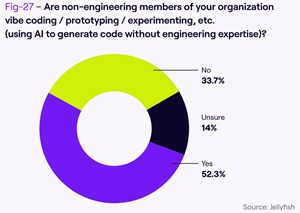 [Click on image for larger view.] Vibe Coding? (source: Jellyfish).
The report notes that engineering managers and executives are more likely to endorse this trend than front-line developers. Still, developers appear cautiously optimistic, especially when vibe coding is framed as a way to generate toy prototypes or early drafts that engineers can refine. The report quotes Alex McRoberts, director of software development at Hootsuite, who said: "Vibe coding is an interesting trend, and there are many conflicting definitions of what it actually means. At Hootsuite, we've worked with our marketing teams to introduce them to the concept of vibe coding, so they can come up with toy prototypes of ideas. This in turn has allowed developers and designers to iterate on these ideas faster."
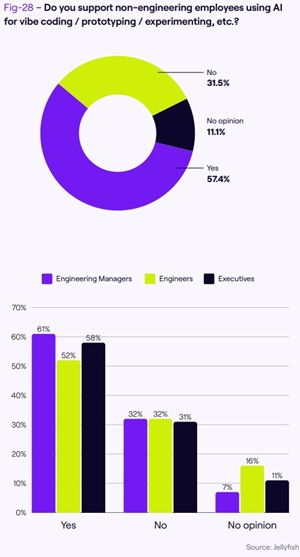 [Click on image for larger view.] Vibe Coding Support? (source: Jellyfish).
While the report acknowledges that vibe coding won't replace traditional engineering anytime soon -- especially for production-grade systems -- it sees promise in democratizing basic automation and expanding software prototyping across organizations. For .NET developers and Visual Studio users, that may mean collaborating with a wider group of stakeholders empowered by tools like Power Platform, Excel with Python, and other natural-language-driven interfaces.
The Tools
Although GitHub Copilot dominates the conversation, the broader landscape of AI-assisted coding tools is still very much in flux, with many organizations experimenting across multiple platforms. According to the report, 48 percent of companies are already using two or more AI coding tools -- a sign that standardization has yet to settle in and that teams are exploring hybrid toolchains to suit different use cases.
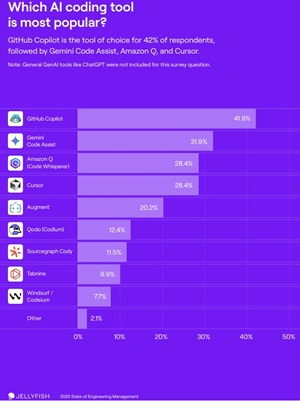 [Click on image for larger view.] Popular AI Coding Tools (source: Jellyfish).
Here's a breakdown of current usage rates among surveyed respondents (general tools like ChatGPT aren't included) in table format:
| AI Coding Tool |
Usage Share |
| GitHub Copilot |
41.9% |
| Gemini Code Assist |
31.9% |
| Amazon Q (CodeWhisperer) |
28.4% |
| Cursor |
28.4% |
| Augment |
20.2% |
| Qodo (Codium) |
12.4% |
| Sourcegraph Cody |
11.5% |
| Tabnine |
9.9% |
| Codeium / Windsurf |
7.7% |
| Other |
2.1% |
The dominance of Copilot -- with a lead of over 10 percentage points against its closest competitor -- reflects not just tool preference, but Microsoft's ecosystem strength. Copilot is deeply integrated with Visual Studio, VS Code, and GitHub, giving it a natural foothold in many enterprise dev environments. That advantage is particularly meaningful to .NET shops already operating inside the Microsoft stack.
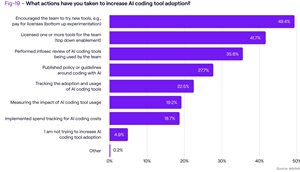 [Click on image for larger view.] Increasing Tool Adoption (source: Jellyfish).
Jellyfish also details how companies are scaling these tools internally. Key strategies include:
- Encouraging bottom-up experimentation (49.4%)
- Top-down licensing of preferred tools (41.7%)
- Running infosec reviews (35.6%)
- Publishing formal usage policies (22.5%)
While most companies are still experimenting, there's a clear trend toward formalizing AI adoption. Organizations are blending exploratory behavior with structured enablement -- a combination that reflects the tension between developer-driven innovation and the enterprise need for governance, policy, and ROI tracking.
As Lau put it in the report, "unlocking [AI's] full value demands more than access." Copilot's early lead suggests that, for many teams, the fastest way to start is with the tool already embedded in their IDE.
More Highlights
Other key takeaways from the report include:
- Significant productivity expectations: 67 percent of respondents predict that developer velocity and productivity will increase by at least 25 percent in 2026 due to AI coding adoption.
- Roadmap work expected to grow: 44.2 percent of respondents anticipate spending more time on roadmap-driven development and less on maintenance (KTLO) work as AI tools mature.
- Limited impact measurement: Despite widespread usage, only 20 percent of teams report tracking the impact of AI coding tools using engineering metrics or software engineering intelligence platforms.
- Budget shifts fueling AI adoption: 38.7 percent of companies are investing net-new budget in AI tooling, while 23 percent are reallocating funds from headcount -- a trend indicating AI is being positioned as a potential replacement for growth in staffing.
- Multi-tool strategies are common: 48 percent of organizations use two or more AI coding tools, suggesting that most teams are still evaluating multiple platforms rather than standardizing on one.
- Formal enablement strategies emerging: 41.7 percent of organizations report top-down licensing of AI coding tools, and 22.5 percent have published formal AI coding policies -- signs that companies are moving past experimentation.
- Offshoring trends tied to cost and flexibility: 45 percent of respondents expect to increase offshoring in the coming year, and 43 percent believe they will see greater savings per offshored role.
- Developer burnout remains a concern: 46.4 percent of respondents expect burnout rates to rise, with only 21.3 percent predicting a decrease -- a potential warning sign amid accelerated AI adoption.
- Internal Development Platforms still early-stage: Only 11.3 percent of respondents say they have fully implemented an IDP, though 64 percent are either planning or partially implementing one.
These trends suggest that while tools like GitHub Copilot are rapidly reshaping how teams write code, the deeper organizational work -- measurement, enablement, and culture change -- is still catching up.
About the Author
David Ramel is an editor and writer at Converge 360.