News
Open VSX 1.0.0 Puts Focus on Open Extension Registry for VS Code Ecosystem
Eclipse Open VSX has reached version 1.0.0, a milestone that the Eclipse Foundation is presenting less as a feature release and more as a marker for an open extension registry that has become part of the VS Code-compatible tooling ecosystem.
The Eclipse Foundation announcement says Open VSX was created to address a practical problem: As the Visual Studio Code extensibility model became widely used across developer tools, vendors wanted compatibility with that extension ecosystem without depending on a proprietary marketplace operated by one company. The post describes Open VSX as a vendor-neutral, open source governed alternative for editors, IDEs, cloud development environments and AI-powered developer tools.
For VS Code extension developers and publishers, that makes Open VSX part of the broader market around VS Code-compatible tooling rather than a replacement for the VS Code editor itself. The project is centered on the extension registry layer: how extensions are published, found, distributed and consumed by tools that use the VS Code extension model.
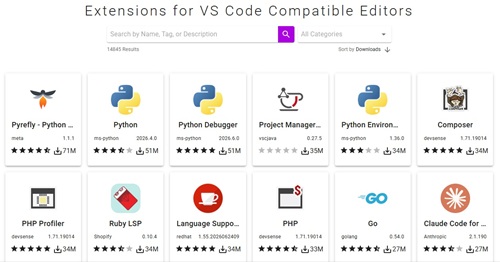 [Click on image for larger view.] Open VSX (source: Open VSX).
As can be seen in the respective screenshots of the Open VSX and Visual Studio Code Marketplace sites where extensions are listed by installs/downloads, Python tools are super popular on both. Popular for Open VSX, however, means some 51 million downloads, whereas it means some 224 million downloads from Microsoft's marketplace.
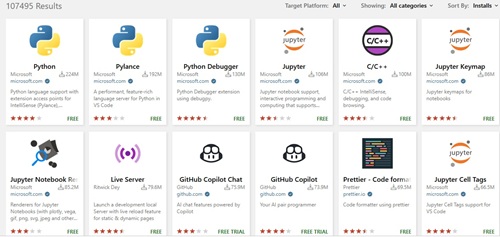 [Click on image for larger view.] VS Code Marketplace (source: Microsoft).
What Open VSX Does
The Open VSX GitHub repository describes the project as "a vendor-neutral open-source alternative to the Visual Studio Marketplace." It provides a server application that manages VS Code extensions in a database, a Web application similar to the VS Code Marketplace and a command-line tool for publishing extensions similar to vsce. The public registry runs at open-vsx.org.
In practical terms, Open VSX gives VS Code-compatible tools a registry for extension discovery and distribution. The Eclipse announcement says the project started as a solution for VS Code-compatible tools and has evolved into infrastructure used by a broader landscape of developer tooling. It also says the registry now delivers more than 600 million extension downloads per month.
That role is distinct from Microsoft's Visual Studio Marketplace. Microsoft's marketplace remains the marketplace associated with Visual Studio and Visual Studio Code, while Open VSX is presented by the project as an open source and vendor-neutral alternative for VS Code extensions.
Why the Project Exists
The Eclipse Foundation announcement frames Open VSX around openness, interoperability and governance. It says the VS Code extensibility model became a de facto standard across modern developer tools, creating demand for a registry that could serve tools compatible with that ecosystem without tying them to a marketplace controlled by a single vendor.
The earlier evolution of the project also reflects that philosophy. In 2021, Visual Studio Magazine reported that the Eclipse Foundation had taken over the Open VSX Registry from TypeFox, which founded Theia, an extensible platform for building multi-language cloud and desktop IDEs with Web technologies. That report cited Eclipse Foundation statements that Open VSX was intended to provide a level playing field, with no single company or vendor owning the registry servers, operating the service or having more control than other participants.
The 2021 report also said Open VSX included a registry server, Web interface and CLI, along with an API positioned as an alternative to Microsoft's VS Code Marketplace API. That same basic structure remains visible in the current GitHub repository, which lists the server application, Web application and publishing command-line tool as core parts of the project.
How It Evolved
The new 1.0.0 announcement says the project is not new with this release. It says Open VSX has served users and tooling ecosystems for years, supported millions of extension downloads, attracted a contributor community and become part of the developer tooling landscape.
The announcement credits early work by TypeFox and contributors including Miro Spönemann and Jan Bicker. It says the first Eclipse Foundation deployment of the Open VSX Registry runtime was established to serve the Eclipse Theia ecosystem, giving that IDE platform an open and vendor-neutral extension registry compatible with the Visual Studio Code extension ecosystem while remaining independent from Visual Studio Code itself.
From there, Eclipse says Open VSX expanded beyond Theia to serve a wider group of products and platforms. The announcement does not provide a full current product list, but it identifies the categories as editors, IDEs, cloud development environments and AI-powered developer tools. Visual Studio Magazine previously reported that products and platforms supporting Open VSX Registry extensions included Salesforce Code Builder, Google Cloud Workstations, Gitpod, SAP Business Application Studio and applications based on Eclipse projects.
What Version 1.0.0 Signals
The 1.0.0 release does include technical changes, but Eclipse's own framing emphasizes maturity and community more than individual features. The announcement says reaching 1.0.0 "marks more than a collection of features or bug fixes" and reflects "years of collaboration, thousands of commits, countless discussions, and a shared belief that an idea is worth building together."
The release notes include production-oriented items such as read-only mode, TLS-secured Redis connections, security hardening, operational reliability improvements and work on deployment and maintenance workflows. Those details matter because Eclipse describes Open VSX as infrastructure for other developer tools. For a registry used by publishers, tool vendors and end users, operational and governance characteristics are part of the product story.
The Eclipse announcement also connects the public open source project to Open VSX Managed Registry, which it describes as a production-grade service for organizations that depend on Open VSX at scale and require operational guarantees, support and SLA-backed reliability. The managed registry site describes it as a production-grade extension registry service.
What It Means for VS Code Developers
For developers who build VS Code extensions, Open VSX provides another distribution path for extensions that can be consumed by VS Code-compatible tools. The project repository says its CLI is used for publishing extensions, similar to vsce, while the registry provides a Web experience similar to Visual Studio Marketplace.
For developers who use VS Code-compatible environments beyond Microsoft's VS Code product, the registry provides an extension source aligned with tools that depend on the VS Code extension model. For tool vendors, the Eclipse Foundation's stated value proposition is a registry governed as open source rather than operated as a proprietary marketplace by one company.
About the Author
David Ramel is an editor and writer at Converge 360.