News
.NET MAUI, ASP.NET Core Polished in First Release Candidate for .NET 9
Microsoft shipped the first release candidate for .NET 9, which is nearing feature completeness and production readiness in advance of its November debut.
As a release candidate, the new release doesn't introduce any new major features or functionality, but rather, as the release notes for .NET MAUI say, "This release is focused on quality, housekeeping, and resolving issues to stabilize the impending GA release."
For example, a major highlight of .NET MAUI in .NET 9 RC1 is simply the ability to "Justify" -- or horizontally align -- text in Labels.
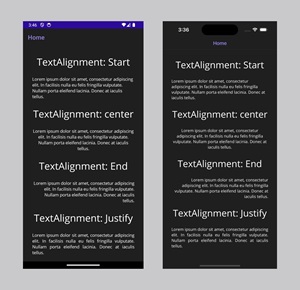 [Click on image for larger view.] Justifying Label Text (source: Microsoft).
Other work focused on quality improvements for .NET for Android and .NET for iOS.
ASP.NET Core Updates
Here, tweaks included improvements to SignalR distributed tracing, which now includes these capabilities:
.NET SignalR client has an ActivitySource named "Microsoft.AspNetCore.SignalR.Client." Hub invocations now create a client span. Note that other SignalR clients, such as the JavaScript client, don't support tracing. This feature will be added to more clients in future releases.
Hub invocations from the client to the server now support context propagation. Propagating the trace context enables true distributed tracing. It's now possible to see invocations flow from the client to the server and back.
Other tweaks for ASP.NET Core in .NET 9 RC1 include:
- Keep-alive timeout for WebSockets: The WebSockets middleware can now be configured with keep-alive timeouts.
- Keyed DI in middleware: Middleware now supports Keyed DI in both the constructor and the Invoke/InvokeAsync method.
- Override InputNumber type attribute: The
InputNumber component now supports overriding the type attribute. For example, you can specify type="range" to create a range input that supports model binding and form validation.
- Trust the ASP.NET Core HTTPS development certificate on Linux: On Ubuntu and Fedora based Linux distros,
dotnet dev-certs https --trust will now configure ASP.NET Core HTTPS development certificate as a trusted certificate for Chromium (Edge, Chrome, Chromium and so on) and Mozilla (Firefox and so on) browsers, as well as for use with .NET APIs (HttpClient and so on). Previously, --trust only worked on Windows and macOS. Certificate trust is applied per-user.
More minor work done on libraries, the SDK and more is explained in the .NET 9 RC 1 #9496 discussion on GitHub.
About the Author
David Ramel is an editor and writer at Converge 360.