
VS Code forks like Cursor, Windsurf, and Google Antigravity may share a common foundation, but hands-on testing shows they reflect sharply different philosophies around AI autonomy, workflow structure, and developer control.

A hands-on comparison shows how Cursor, Windsurf, and Visual Studio Code approach text-to-website generation differently once they move beyond the basics and begin redesigning and extending their own work. One thing that stood out is that, despite their sophistication, these AI-assisted editors remain a long way from agentic AI.

A recursive vibe journalism experiment in which Microsoft 365 Copilot's "Prompt Coach" agent is used to wholly create an article on how to use "Prompt Coach" agent to prompt M365 Copilot.
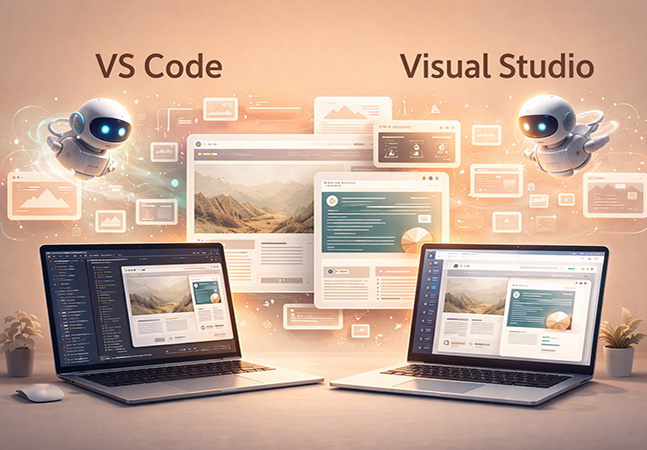
What a difference a year makes in the fast-moving advanced-AI space! GitHub Copilot's vision and image-based features arrived first in VS Code in February 2025 and have since become more integrated there, while Visual Studio is beginning to add similar capabilities through Copilot Chat in a more limited form. Here's a hands-on demo of what you can do now in both.
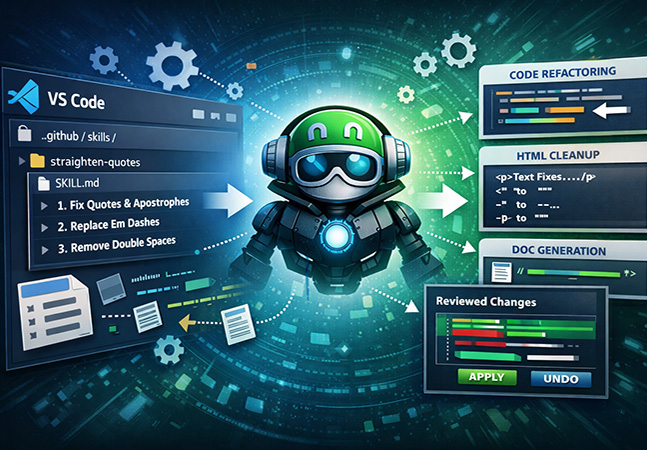
Visual Studio Code 1.108 introduces Agent Skills for GitHub Copilot, enabling developers to define reusable, domain-specific automation that can handle everything from code refactoring to custom text and formatting cleanup.

GitHub CEO Thomas Dohmke shared a tip for faster "vibe coding" in VS Code’s agent mode, one more step toward making Copilot feel like an autonomous AI coding assistant.

Some developers complained that advanced AI models come sooner to VS Code than Visual Studio, but the new Claude Sonnet 3.7 model is now available in IDE with a paid GitHub Copilot account and a simple settings tweak in GitHub.

New Vision support with GitHub Copilot in the latest Visual Studio Code Insiders build takes a user-supplied mockup image and creates a web page from it in seconds, handling all the HTML and CSS.

Chances are if you've had many coding interviews you've been presented with a poker problem. Here's a great take from Dr. James McCaffrey of Microsoft Research.
- By James McCaffrey
- 04/04/2024
Can advanced AI in Visual Studio 2022 turn the sophisticated IDE into a replacement for low-code tools that is suitable for non-coders to create business apps?
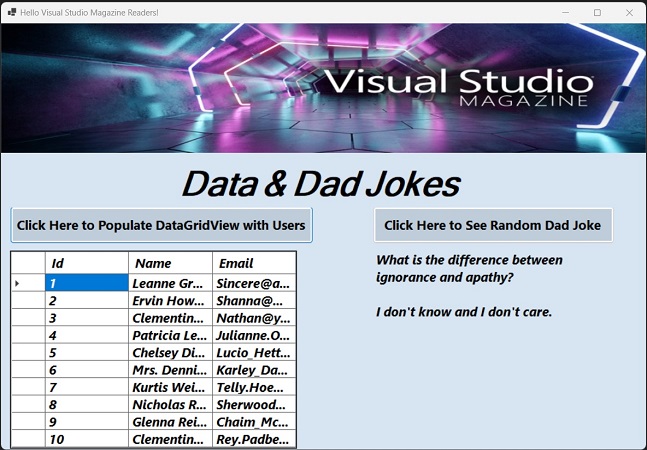
Wherein our intrepid editor serves as a test case for "ordinary business users" and "citizen developers" to slip the surly bonds of low-code and rise to more sophisticated development tooling with the help of Copilot/Chat.

Dr. James McCaffrey of Microsoft Research explains GMM clustering in a full-code, step-by-step tutorial, noting his data scientists colleagues have different opinions about the complicated technique.
- By James McCaffrey
- 11/01/2023

Dr. James McCaffrey of Microsoft Research says the technique is easy to tune, works well with small datasets and produces highly interpretable predictions, but there are also trade-off cons.
- By James McCaffrey
- 10/02/2023

GPR works well with small datasets and generates a metric of confidence of a predicted result, but it's moderately complex and the results are not easily interpretable, says Dr. James McCaffrey of Microsoft Research in this full-code tutorial.
- By James McCaffrey
- 09/15/2023

KRR is especially useful when there is limited training data, says Dr. James McCaffrey of Microsoft Research in this full-code, step-by-step tutorial.
- By James McCaffrey
- 08/15/2023

Implementing LRR from scratch is harder than using a library like scikit-learn, but it helps you customize your code, makes it easier to integrate with other systems, and gives you a complete understanding of how LRR works.
- By James McCaffrey
- 08/01/2023

Dr. James McCaffrey of Microsoft Research offers a full-code, step-by-step tutorial for this technique, especially useful when there is limited training data.
- By James McCaffrey
- 07/18/2023

Easy-to-make tools can provide just about whatever functionality you need instantly with a three-stroke key combination.

So you've finally been plucked off the GitHub Copilot chat waitlist. Now what?

Dr. James McCaffrey of Microsoft Research uses a full-code, step-by-step demo to predict the species of a wheat seed based on seven predictor variables such as seed length, width and perimeter.
- By James McCaffrey
- 05/15/2023

Dr. James McCaffrey of Microsoft Research uses a full-code, step-by-step demo to show how to predict the annual income of a person based on their sex, age, state where they live and political leaning.
- By James McCaffrey
- 05/02/2023

A full-code demo from Dr. James McCaffrey of Microsoft Research shows how to predict the type of a college course by analyzing grade counts for each type of course.
- By James McCaffrey
- 04/17/2023

Dr. James McCaffrey of Microsoft Research says a neural network model is arguably the most powerful multi-class classification technique.
- By James McCaffrey
- 04/03/2023

Decision trees are useful for relatively small datasets that have a relatively simple underlying structure, and when the trained model must be easily interpretable, explains Dr. James McCaffrey of Microsoft Research, who provides step-by-step instructions and full source code.
- By James McCaffrey
- 03/17/2023

Dr. James McCaffrey of Microsoft Research shows how to predict a person's sex based on their job type, eye color and country of residence.
- By James McCaffrey
- 03/01/2023